Showing posts with label history. Show all posts

Friday, October 15, 2010

Dropping the Ball

It's been one week since we prematurely ended the U.K. ration portion of our experiment. I've been doing a lot of soul searching since then.

Don't worry; we're still following our U.S. rationing guidelines. It was very easy to fall back into that groove: red points, blue points, etc.

But it feels different this time.

You see, living on U.K. rations was nothing less than hard: each day I had to carefully manage our limited supplies - what fat was available, what would do for breakfasts, and what pantry items were of adequate supply to provide enough dinner for four. The girls were hungry; we were all hungry.

I imagine that, historically, the hardship might have been more manageable if the entire country could commiserate with the shortages and make-do recipes and the hunger (in-between air raids, that is).

But in the U.S. things were different. Sure, there were shortages and occasional items were missing from the shelves. But what has become apparent from this (now over nine month) experience is that U.S. rations during WWII were generous compared to our own Allies across the pond. There was enough that the U.S. could help supplement British diets with exports of canned meat, fruit and vegetables. This was because U.S. food production (both private and commercial) skyrocketed during the War. Between Victory Gardens and factories running 24/7 the availability and variety of foods in America during the War made the grocery store shelves in the U.S. look like technicolor versions of heaven to the impoverished abroad.

And at least during this part of the War Americans had their heads and hearts in the right place: in a 1943 poll 62% of American respondents thought that continued rationing after the War would be necessary for a year or two to better control shortages and continue supplying war-torn nations with much needed food. By 1944 that number had risen to 85%; images of starving children in Europe and Asia were finding their way into U.S. media and it was hard to argue with such evidence. In 1945 individuals in Tokyo were getting only half of their official ration allowances (520 calories a day); at the same time over 70% of Americans thought it in the country's best interest to help overseas after the War.

And then something happened: the War actually ended.

As of August 15, 1945 (the day after V-J Day), rationing in the U.S. was over. History. Tired of the cumulative deprivation that was the Great Depression and WWII, Americans were happy to once again experience a lifestyle of abundance and leisure.

By March of 1946 only 59% of Americans favorite a return to rationing in order to send food to the needy in other nations (and that number dropped even further if the receiving nation was in Asia). Persuaded by the manufacturing and farm lobbyists, most Americans began to believe that advances in science and technology would be the way to rescue the international community out of poverty.

Granted, there was a group of citizens and activists that were not happy with this complacency towards the hungry. Pressure from voters and cabinet members lead President Truman to hastily create the Famine Emergency Committee in the spring of 1946. The FEC emphasized the notion that no other country, aside from Canada, could provide the food needed to rescue the rest of the world from starvation. To accomplish this they recommended that Americans return to rationing. When it became clear that neither industry nor the government was interested that option, the FEC recommended that Americans reduce their wheat consumption by 40% and their usage of fats/oils by 20%.

The response was underwhelming. In a 1947 Gallup Poll only 22% said they followed the government's suggestion of meatless Tuesdays (although 38% said they were planning to follow it). Roughly 29% of respondents replied that eating no meat on Tuesdays was "too difficult." Meanwhile, photos of the food wastage transpiring in the U.S. did little to gain sympathy from world communities that were continuing to suffer from drought conditions and the effects of war.

I know what you (the Americans) are thinking: what about the Marshall Plan? We all learned about the wonders of the Marshall Plan in our high school history classes; how it helped build up Europe after the War and created an efficient, sustainable infrastructure. But do you remember that the Marshall Plan wasn't enacted until 1948 - a full three years after WWII ended? And that only 29% of the multi-billion dollar program went to supply food, feed and fertilizers? The rest was spent on factories, buildings, and roads. And since food supplies were tied with politics, the amount of aid sent to Asian countries during this time period was but a small sliver of the amount sent to Europe.

So what am I trying to say? I'm saying that the U.S. blew it. Dropped the ball 100%. We had the chance to raise millions of lives out of poverty (and even prevent innocent deaths), but in the end we chose a nice steak dinner and chocolate cake rather than subject ourselves to modest, manageable rationing program.

And in reality, things really aren't that different today. The U.S., along with Canada, has the fields, the factories and the transportation needed to provide poverty relief both locally and around the globe.

So when this modern mother had to listen to her children's' repeated requests for food because they were genuinely hungry (and not just bored), it was a wake up call. What was a choice for me (living on restricted rations) is someone else's reality. Today.

According to the World Health Organization, approximately one-third of the world is well fed, one-third of the world is underfed, and one-third of the world is starving. Today.

Meanwhile, incidents of childhood and adult obesity in the U.S. are skyrocketing.

The system is broken. I'm not saying that it's an easy fix, or that it will ever be perfect. But something has to be done - locally and internationally.

And you know what? I'm not going to be the one to drop the ball this time.

--Rational Mama

Saturday, August 14, 2010

Historic Recipe: Jellied Ham Loaf

This is yet another recipe from Betty Crocker's rationing recipe booklet. Now, there's been more than one recent work of web-based journalism covering some of the horrific concoctions we Americans have managed to create with humble Jell-O. Since most of these stories end with me throwing up in my mouth a little, I was a dubious about trying a meated gelatin recipe. I don't even like most of the fruit-based Jell-O recipes. But, in fairness to the rationing year and to those generations who grew up during WWII (and its shadow) I decided, despite my misgivings, that it was a must.

After all, serving a Jell-o dish during the summer was a sign of wealth in the late 1930's/early 1940's. Since Jell-O (and any gelatin, for that matter) requires a cool environment to set, serving a Jell-O-based dish in the summer heat was a subtle yet unmistakable way of saying,"Take, that, hussy - my man can afford to buy me a refrigerator," at the neighborhood picnics.

Despite this status I did have one very strong warning from friend/colleague Ms. Grasslands when she heard the next historic recipe was to be a jellied ham loaf. "Jellied ham loaf," Ms. Grasslands wrote, "Was literally the only dish I could not eat as a child. It made me choke. I could eat everything else you've blogged about, including liver and onions, heart, tongue, but not ham loaf. I'm retching even as I type." Egads. This definitely made me second guess my choice, especially considering how our last historic loaf recipe turned out. But, I made a firm decision to be optimistic. After all, this was a rationing recipe that did not require a white sauce (gasp!) and, as TMOTH pointed out, we'd basically just be making our own SPAM. Right?

Before we get too far into the details of the recipe, I want to point out that the first ingredient listed is ham shanks. This is one of those mythical meats that I've heard of but never purchased and really have no idea as to it's original placement on the pig. The first result from my Google search entitled, "What is a ham shank?" informed me that it is, apparently, a pithy name for an act of masturbation. Umm...luckily the second result informed me that a ham shank is from the lower portion of the pig's leg. According to this source, ham shanks have less fat and are not as meaty as the traditional butt end ham.


Rationing-wise they're also considerably cheaper on the point scale than traditional ham. On our handy-dandy chart ham shanks are five points a pound, whereas traditional ham is a whopping 12 points per pound. I'm sure this fact alone made creative ham shank recipes popular during WWII rationing.

Here's a quick run-down of the recipe:

1. Simmer 2 1/2 pounds ham shanks in a pot of water for two hours.
2. Pull ham meat from the bone and grind enough meat to make 2 cups.
3. Soften 1 TB gelatin in 1/4 cup cold water.
4. Dissolve 2 beef bouillon cubes in 2 cups hot ham stock.
5. Combine gelatin mixture, bouillon mixture and ham together with 2 tsp horseradish, 2 tsp prepared mustard and 1 1/2 cups corn or bran flakes.
6. Chill until firm in oiled bread loaf pan.
7. Unmold and slice.

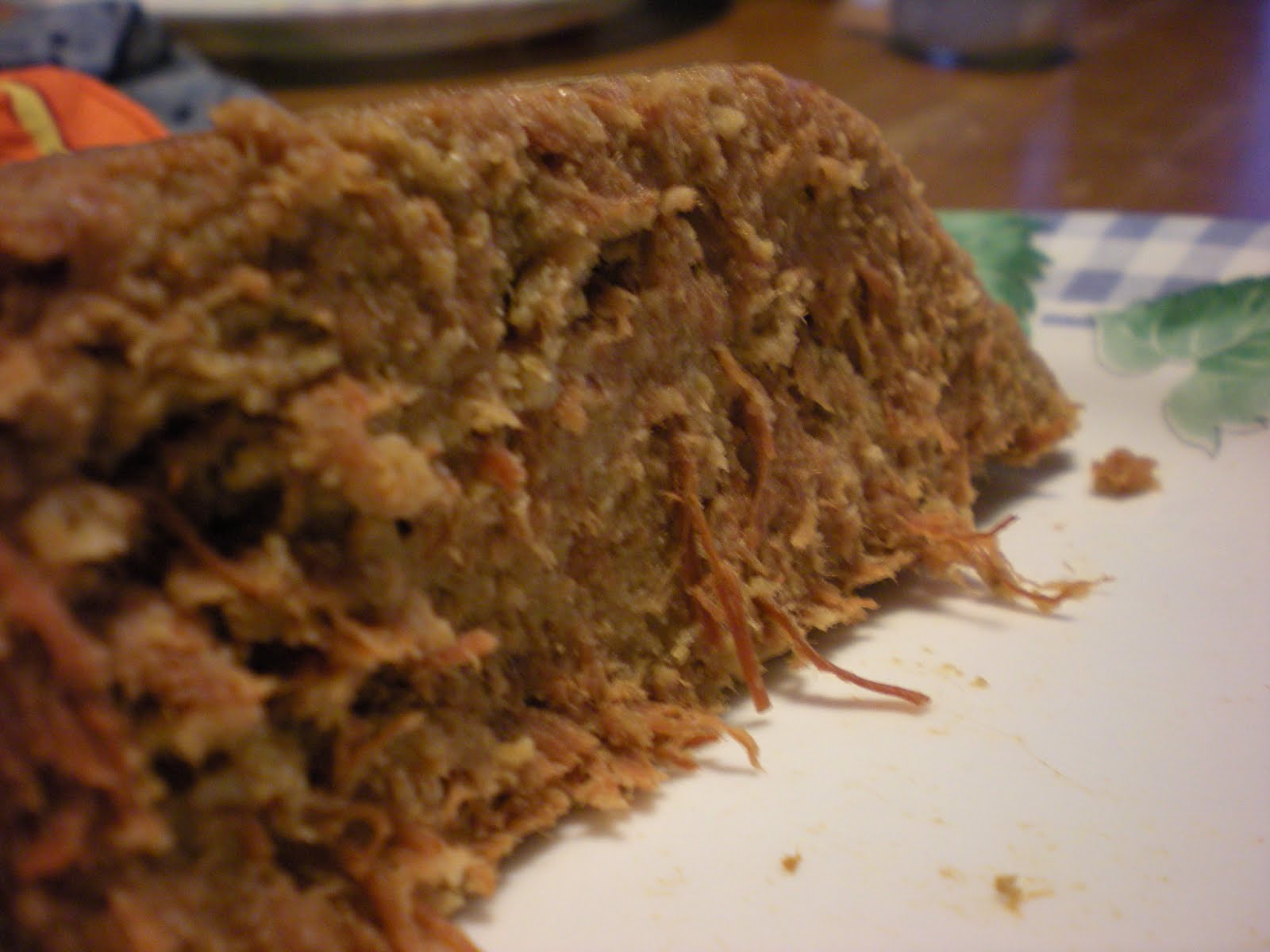
Let me tell you that there is nothing pretty about this recipe. Ground ham shank looks like reject dog food and once you combine it with the bran flakes and warmed broth/gelatin mixture it looks more like a science experiment gone horribly wrong rather than something edible (at least, something edible to an organism that lives outside of a petri dish). Rather than pat it into a loaf pan I used a roundish bowl instead. I felt like the cubic confines of the loaf pan could not contain the organic awesomeness of the ham loaf. That, and I thought it would look prettier on a plate if it was round.

Oh, and I was very much thankful that the girls were not in the kitchen while I made this up in the morning. I knew that if they saw the taupe, viscous mixture in its un-gelled state then it would be over before it all began.

After a very hot day (automobile thermostat declared the outside temperature at 112 degrees at one point) which included swimming, piano practice, laundry and such dinner was a snap since all I had to do was cook the fresh corn on the cob and decoratively arrange the jellied ham loaf on plate. Of course, I still had to get the loaf out of the mold.

Now, when the directions said to place the concoction in a oiled pan, I took the "oiled" part seriously, slathering what seems like way too much canola oil along the inside of a metal mixing bowl. I assumed that this ensured a nice, quick slip of the molded meat onto the plate come dinner time.

I was wrong.

My first attempt at flipping the loaf bowl contents onto a plate resulted in...nothing. So I kept the bowl turned over on the plate and hammered the outside of the bowl with the blunt end of a wooden spoon. Still, no slippage.

I took a butter knife and ran it around the outside edges of the loaf, sure that it would release the mold just as the same technique releases a cake from its pan. No go. Not even when I banged it some more with the wooden spoon.

Did Newton every write a law about the physical inertness of jellied meats?

Confounded, my next act was to use said butter knife to slide around the side of the loaf again and pry the bottom off of the bowl's surface. A quick flip over onto a plate and...nothing. A few more thumps of the wooden spoon and soon I heard the satisfying slurping noise of the loaf disengaging from the bowl and landing firmly on the plate.

Thank goodness I didn't use a real fancy mold or else I would never have been able to get the loaf out in one piece.


And yes, friends, it was very reminiscent of the sound molded moist cat food makes as it slurps out of its tin can and into kitty's dish. And you know what, it looked a lot like it, too.

When I sat the jellied ham loaf on the table for dinner the girls gave it a quizzical look and proceeded to poke it, as they had previously done with the SPAM. After asking them to stop poking the meat I used a knife to carve slices off the loaf. "Carving" might be a a generous term to describe the sectioning of the loaf, since it didn't slice very cleanly. I placed portions on each of the girls plates (along with a squirt of the obligatory ketchup) and waited for them to take a taste.

Since it was not a bean or vegetable-based dish Sissy was the first to dive in. "It tastes a lot like SPAM," she replied, and soon Eowyn was taking a bite of her slice. Eowyn agreed with the SPAM comparison. And then they kept on eating.

TMOTH and I both though the loaf was palatable, but suspected it would be better pan-fried (if the gelatin would hold up to the heat).

At one point one of the girls said, "It would be better in a sandwich, with ketchup and mayonnaise." Actually, that must have been Sissy because she thinks anything can be made better with mayonnaise. We all agreed with her statement so off she went to get bread from the kitchen. And she then proceeded to eat another slice of the jellied ham loaf while Eowyn finished all of her original slice and had a few bites of another.

So, I guess this was, surprisingly, a success. Go figure.

As for leftovers - oh, there are leftovers! The recipe says it will feed 8 to 10 people and I wish I would have read that before I made the recipe. I took a few slices in my lunch the next day and under the fluorescent glow of the break room the loaf definitely look less edible - mottled grays and pinks with an occasional ham string hanging out. I quickly ate my slices before anyone else came in to the room so that I didn't have to explain why I was eating cat food.

The next day I asked the girls what they have for lunch (they were home with TMOTH), and they said they had ham loaf sandwiches. "Were they good?" I asked. "Yes." was the unanimous reply.

Will we make jellied meat loaf again? Well, I don't plan to - at least, not immediately. I'm happy enough to say we made it and ate. Of course, we never know what the Randomizer will throw at us...there may be some week where all the red points we can afford for meat will make ham shanks (the meat, not the act) look like a good deal. In that case, jellied ham loaf it is.

At least it's not jellied pigs feet.
--Rational Mama

P.S. This seems to be the Rational Living post with the most potential for sexual euphemisms, considering the mentions of ham shanks, butt ends, meat grinding, and meat poking. Don't worry, we won't have our heads in the gutter for too long.

Wednesday, June 23, 2010

If You Can't Stand the Heat...

You know that scene near the end of The Wizard of Oz, where Dorothy finally throws the bucket of water on the Wicked Witch of the East and, dripping from head to toe in her drenched black garment, the villainess screams, "I'm melting! I'm melting!"

Well, that was me at 2:00 this morning.

Except that I'm not green, nor was I wearing a black cloak and gown and what I was drenched in was sweat, not plain water. Of course, this begs the question - did plain sweat not affect the Wicked Witch of the East? She had to have been hot in that get-up...maybe the saltiness of sweat rendered it ineffective, or maybe her evil castle lair was air conditioned?

Anyway...we had been doing pretty well with no air conditioning in the Rational Living household the past few weeks. The formula was simple: run the attic fan in the early morning to pull in the cool overnight air, then shut the windows. By the time the house was heating up into the uncomfortable range (mid-80's) it was nighttime and we could once again run the attic fan before bed to cool the house down and start the cycle all over again.

But the last few days have been absolutely miserable. Nighttime temperatures have been hovering around 80 degrees - hardly cool enough to make the house bearable. Several days of this in a row and the house was downright tortuous.

To make matters worse, we've been very short on sleep lately, due to near-nightly storms (with lots of blinding lightning and deafening thunder) and the hot, hot weather. While what we've been experiencing is nothing like the countless night raid sirens civilians in the UK had to endure during WWII (sometimes multiple times in an evening), I do have to say I feel a little connection to the sleep deprived, is-this-ever-gonna-stop exhaustion expressed by the family on The 1940's House.

All of this combined lead to my 2:00am outburst of "I'm melting!" last night. According to the thermostat on the main floor the house temperature was 87 degrees at that time; considering the upstairs is significantly warmer, the bedrooms were most likely around 90 degrees. At 2:00am (which is a painful time to be awake, mind you) it was 83 degrees outside which, combined with the 70% humidity created a heat index of 89 degrees.

This implied that the heat index in the bedrooms was probably close to 95 degrees.

Running the attic fan would do no good. The girls were only barely asleep, their poor little bodies sweating away the night. We were all sleep deprived.

And so TMOTH and I agreed to turn on the air conditioner, but to set the thermostat at 85 degrees. I have to admit I was afraid it wouldn't come on, the result of some sort of Murphy's Law affect on our 30 year old air conditioner.

Oh, but it DID come on...and even though the temperature did not drop dramatically the humidity was sucked out of the house.

And it was wonderful.

Going forward, we've agreed to use the air conditioner when we are not able to get/maintain the inside temperature of the house at or below 85 degrees. The self-imposed "no air-conditioning" rule for the rationing year has bit the dust.

Still feeling a pain of guilt (and secretly wondering if we're all a bunch of wusses) I e-mailed a friend today, seeking clarification. Ms. Hyldi was born at the beginning of the Great Depression and so was a young teen during WWII. I know she regularly uses her attic fan and sets her air conditioning thermostat at 85 degrees (that's where we got our compromise number). I asked her how folks during the 1940s kept cool, and this was her response:

"...[T]he climate was different — just out of the dust bowl days, the humidity was quite low.

We moved from one house to another in 1942; in both homes, I slept in a large upstairs room with windows on all four sides, so all the breeze possible came through. The 2nd house had large trees shading it, and that helped some, too. I spent time in the porch swing — swinging made a breeze.

During those years, our family had two oscillating fans — one large and one small. The small one was moved to wherever it was most needed. The large one was part of our evaporative water cooler — a contraption built by my dad. It consisted of a thick layer of excelsior (the packing material) between two panels of chicken wire in a wooden frame and installed in a south window. Along the top was a trough with numerous drain holes. We hooked the garden hose to it and turned it on to a drizzle. The water trickled through the excelsior and with the south wind and the help of the large fan inside, cooler air came through into the house. Lots of people had them — if they couldn't build them, they could buy commercially built ones at hardware stores. But they were ineffective once the climate became more humid. We always turned it off and night. I imagine my parents used the small fan in their bedroom, but I don't remember.

We, and hundreds of others, often slept outdoors. We'd take a rug or blanket and put it on the grass and sleep until the sun came up. People who didn't have a yard slept in the parks, something you'd have to be out of your mind to do now. We also often carried around wet washcloths. Sometimes we'd wrap them around ice, and apply them to our faces and necks.

When I was little, I spent most of the summer months in Western Kansas on my grandparents' farm. The days were blistering hot, but mostly, the nights were cool because the sandy soil didn't hold the heat. In 1936 (I think it's still considered the hottest Kansas summer ever), I remember going with my grandmother to a women's meeting in a home, and we were greeted at the door by the hostess who handed each of us a wet towel. There was one night that summer when there was absolutely no breeze and we all woke up hot. My grandfather went down to the milk house and turned on the windmill to get us some cool water to drink — the only source of anything cool on a farm with no electricity. There wasn't enough wind to even turn the windmill! The slightest movement of air would turn it, so that was incredible!"

I really appreciated her response - it made me realize that people were driven to extremes by the heat back then, just as they can be today. It also taught me that the use of swamp coolers was more widespread than I ever realized, which made me feel slightly less guilty about using our air conditioner if it is set at 85 degrees.

Tonight after I walked home from work in weather with a heat index of 96 degrees I entered a house cooled to 85 degrees...and it really feels quite wonderful. Before the rationing year we would typically set the air conditioning thermostat at 78 degrees, but now I realize that 85 degrees might be a better compromise between our physical/mental well-being and our desire to live more responsibly. This might just be a change that sticks around.

In the meantime there is a cold(ish) front moving through tonight that is supposed to bring us nighttime low temperatures back in the upper 60s/lower 70s for the next several days, so I'm hoping we can avoid using the air conditioner again until the weekend.

How about you, dear reader? How are you managing the heat?

--Rational Mama

Wednesday, June 9, 2010

This (Damn) Old House

Yesterday, at one point, it was 82 degrees outside with a humidity level of 83%.

My personal opinion is that the numerical value of the humidity level shouldn't exceed the numerical value of the temperature. It was sticky, sticky, sticky. Oh, how air conditioning would have magically sucked that moisture out of the household! But alas, it is not an option this year.

Definitely a good incentive to get that whole house fan installed soon! A major air movement would have helped for sure.

TMOTH spent the better part of the day yesterday up in the attic to start on said whole house fan project. Seems our 100 year old house doesn't exactly have joists at modern/standard intervals.

This is going to get interesting.

Oh! And while we were checking out the dormer windows (they'll need to be replaced with vents) TMOTH pulled out some insulation-type material that was wedged between the window and the beam. It appears to be a section of some type of insulated clothing from ancient (early 1900s) times - like welder's pants. One of the early inhabitants of our house was a blacksmith, so I wonder if one winter he shoved some old work pants in the crevices of the attic to decrease drafts.

We'll keep you posted on the fan installation - it's going to require some outside-the-box thinking.

And sweating.

--Rational Mama