Never was there a better use of $35.


So simple, so retro. On these nice warm days they practically live on that thing.
--Rational Mama
 This shower head was definitely retro old-school in every way possible, including spray surface area and water output. Pure steel construction made us think that it's the original shower head, which would date it to around 1957. Ah, post-war American...when gluttonous consumption of resources following mandatory rationing was the norm. But an engraving at the base of the head says that it has an output of 2.5 gallons of water per minute, which is technically within modern ranges...
 Not only is it eco-responsible, it gives you the excuse to repeatedly say "Power in your Shower!" in a Mr. T voice.
 During our year of living on World War II civilian rations certain foods and behaviors are restricted. It also means that some behaviors, such as walking to destinations and gardening are encouraged. Another example of this is in regards to emergency preparedness; during WW II the U.S. Civilian Defense Corp organized approximately 10 million civilian volunteers who were trained to fight fires, decontaminate after chemical weapon attacks, and provide first aid and other emergency services.
Our girls our 7.5 yrs and 9.5 yrs old (yes, I have to put the half in there or they will disown me). The diapers served as a stark reminder that we have not been on the up-and-up when it has come to maintaining our emergency preparedness supplies.
Unfortunately, it CAN be too late to be prepared, and there's lots of reasons to be prepared that are statistically more likely than a red alert level on the Homeland Security Advisory System.
Flooding, winter storm, tornado, fire, contamination of public water supplies, pandemic, hazardous materials spill, and sudden unemployment are just a few.
So what do we need to do? Well, there’s various levels of preparedness, and different locations to consider. Ideally, we should have a grab-and-go emergency bag for situations that require short-term relocation, a stockpile of food and supplies for an emergency of longer duration (at least two weeks or so), and a seasonally-appropriate emergency kit in each automobile.We've got a long way to go.
I've asked TMOTH to chair this particular task, so he'll get to spend the next few weeks perusing the various websites and blogs that talk about general preparedness, good things to know for when SHTF (the Sh*t Hits the Fan) happens and ponderings about TEOTWAWKI (The End of the World as We Know It). I have no doubt he will enjoy this task.In the meantime, I'm adding a few no-battery flashlights to this week's shopping list, and am gonna make sure that the hand-crank radio is out and accessible.
Are you prepared, dear reader?--Rational Mama
 All we had to do was add the right kind of worms. And thanks to a generous gift from Karla (an experienced vermicomposter who found herself with too many worms), around one pound of worms were mixed into our own bin today.
 These hardworking little guys and gals...wait, these worms are hermaphrodites...well, then I guess each worm IS a guy and a gal...anyhoo...these little critters will happily decompose the following household waste:


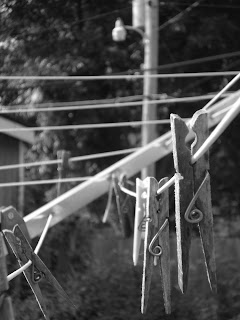 and new found freedoms. Unlike rental units, in which we had lived for the majority of our adult lives (and for me, most of my whole life), the house afforded us opportunities to express ourselves: wall colors, landscaping and custom alterations. But our first project was a cheap (less than $80) addition that we both felt strongly about: the installation of a clothesline.
 Of course, there are those naysayers that poo-poo the idea of clotheslines. Here's a few I've heard:
Don't the birds poop all over the clothes? Umm, no. For this reason I don't recommend putting your clothesline under a tree, but our current clothesline sits under a power line (aka bird wire) and I'm only aware of one "bomb" in the last six years. The odds are clearly in our favor.
Aren't the clothes wrinkled? The condition of your clothes will only be as good as your technique; if you hang the clothes bunched up and wrinkled then that's how they'll dry. A quick shake and careful pinning and clothes are often removed from the line with less wrinkles than if they sat in the finished dryer for 5 minutes past the buzzer.
But the towels are so stiff and scratchy! True, sun dried towels have a different initial texture than towels slathered in petroleum-derived fabric softeners that were dried in fossil fuel-using dryers. But sun dried towels are more absorbent! Seriously, fabric softeners leave a film on fabric that retards absorption. And that characteristic stiffness is short-lived - as soon as you start using a sun dried towel it begins to soften up.
You're not really saving that much money and energy, so why bother? My family does roughly 4 to 5 loads of laundry per week, which translates into about $1.50 worth of savings per week. No, that doesn't seem like much of a savings. But when you consider that clothes dryers account for an average of 15% of a home's utility usage, you can see how using a clothesline is a cheap and easy way to save a bit of your budget. Plus, if all the homes in the United States used clotheslines exclusively for just 5 months out of the year, imagine the reduction in fossil-fuel based energy demand!
Do you use a clothesline? If yes, what are your favorite things about using one? If not, what's holding you back?


