Showing posts with label sustainable living. Show all posts

Tuesday, June 24, 2014

The Honeymoon is Over: Chicken Honesty

You know how at the beginning of a relationship you are always so excited to see the other person, and think that everything he/she does is brilliant and charming and all the stories are new and breathtaking? And how, after time and exposure, the gilt begins to wear off because, seriously - you've already told me this story three times before (and it's really not that funny)? And then you start to see how annoying and selfish that person can be, but you stick it out with them since the positives outweigh the negatives? And then in a few more weeks you're leaving the bathroom door open while you take your morning dump, with yesterday's eyeliner smeared across your cheek and sporting the world's most atrocious morning breath because, well...you just don't care?  Because you're all about honesty now, right?
 
Yeah, so that's sorta how we are with chickens now.
 
When we finally got our first flock of chicks, each fluff-ball was socialized daily, fed from hand and given a special name best suited to his/her personality. Special treats were lovingly offered each day, and every egg was a celebrated as a victory.
 
Fast forward three years later and we are so over that now. We currently have chickens that we've had for close to a year that don't even have a name.  And since we haven't socialized them properly they get all Benny Hill theme music on us (forward to the 1:07 mark) when we try to get close.  Bitches.
 
Don't get me wrong - I don't believe we loath having chickens.  It's just now that all the gilt has worn off and I can be 100% honest with you about it all.  To keep it organized, here are 5 truths about raising chickens that any experienced and honest chicken owner can tell you:
 
1.  Chickens eat a lot.  If you think running to the store because you ran out of dog food (again) is a hassle, just wait 'til you're feeding chickens...especially in the winter.  Since they have less to forage on during the cold months, our girls eat way more feed in the winter than in the summer - pretty much a new bag every week.  And unlike dog food (or cat food), the local gas-and-stop on the corner doesn't have a miniature bag of feed-n-scratch to get you through to the weekend.  No, if you realize at 7:55pm that you are out of chicken feed then you better haul ass to the nearest farm supply store (which closes at 8:00pm) to get that bag.  Unless you have enough stale cereal in the back of the cupboard to buy time.  Otherwise, get used to the folks at the feed store calling you PJ's-and-Crocs (because that's how they're used to seeing you).
 
2.  Roosters are assholes.  Seriously.  There is a reason the term "cock" is used to describe assholes.  People will tell you stories about roosters that were sweet and gentle and loved to cuddle, but they're lying.  Or drunk.  Or both. And notice how their stories are always in the past tense. Rooster have built in shivs, called spurs, on the back of their legs.  They will cut you!  It's just like Wolverine, minus the adamantium and six-pack abs and cigar and...okay, scratch that Wolverine thing.  Unless you are trying to breed chickens and raise chicks from eggs I really don't recommend keeping roosters.  Doubly so if you have young children around. 
 
3.  Chickens die. Okay, this one shouldn't be a surprise, right?  But lets just say that the death isn't always a convenient or peaceful one. We've had a stray dog wander on to property and personally pick out his own al fresco lunch (the owner that let that dog wander was a cock...see what I did there?). Occasionally one will go on a walk-about, while others disappear with nothing but a poof of feathers left in the grass (we suspect hawks in those instances). Sometimes there will just be one sweet little hen dead, near the front door, just in time for your elementary-aged daughter gets off the bus (fuuuuuck). Sometimes you find the body (or remains) after dark when you're locking up the coop. Sure, you could get to bed an hour later than expected by cracking out the shovel and giving it a proper burial.  But tomorrow is trash day...
 
4.  Chickens shit everywhere. No really - everywhere. High, low, sideways - it defies gravity and gets onto every surface. And even if you think you're all that and keep your chickens penned up (no free range poop for you, thankyouverymuch) guess what? You're going to go in to that pen for feeding and watering duties and bring chicken shit back into the house on your shoes. And then unknowingly smear it in the carpet.  Because you're too drunk talking about a sweet little rooster to notice what you've done.
 
5.  Chicken Math = Crazy Math. You're just going to start with eight hens, right? Er, better make that 12. Shit, how did it get to be15? Fuzzy math indeed, my friends. Oh, you're going to downsize your flock? Let me know how that goes - because the universe hears you and calls your bluff and that is exactly when it will bend time and space to steer people into your path that are desperately in search of good homes for chickens they cannot keep. I even know someone who had unwanted chickens dumped on her property in the middle of the night. I kid you not. I've decided I'm not longer going to announce when we are wanting to reduce the size of our flock - it's a bit too much of fate tempting. I'll have to come up with some code phrase.  Maybe instead of saying "We're going to downsize our flock," I should say something like "I wish there was more chicken shit on the sidewalk."  It'd be sort of a reverse-psychology-meets-no-tempting-of-fate approach.  Legit.

I can easily think of four or five other things to add to this list.  But don't get me wrong, chickens are fascinating and entertaining and there is nothing better than home-grown protein.  It's just not always sunshine and roses.

Some days it's more like sun flares and thorns.

--Rational Mama

Sunday, March 20, 2011

Moving On

We did it.

This was the week we made the big move to the little homestead.

Moving is always such a mixed bag of emotions...the purging of belongings, packing of memories, and finding closure with the old in the midst of excitement for the new.

And in the middle of all that poetry there's boxes, boxes, boxes. Boxes to find, boxes to move, boxes to haul up/down stairs, boxes to stack in tipsy-turvy Dr. Seussical fashion and boxes to (eventually) unpack.

We're dealing with those last two descriptions right now. Oh, how I loathe the house when it's in that "forest of cardboard" phase. It's a disaster zone that gets my special kind of crazy going. We spent 15 minutes this morning searching for clean socks and underwear. Seriously.

I've managed to get a few things unpacked, but there are still plenty of boxes to go through. And some things have made it out of their boxes but haven't yet transition to their permanent homes.

Everything is in transition, really...and that includes this blog.

Over the next few weeks you'll notice some changes to the Rational Living blog. Topics du jour will begin focusing on our efforts to live more sustainably on our small acreage, rather than our rationing experiment. There will still be plenty of history lessons as we learn how to expand our home canning, make cheese, raise chickens, make household goods rather than buy them new and the like.

Over the next few weeks, though, we'll be attempting to conquer the cardboard forest. And I imagine that one of the first "new" posts will review the in's and out's of downsizing from 1620 square feet to 940 square feet.

Possession purge, anyone?

--Rational Mama

Sunday, February 7, 2010

A Rational Sunday Program

Last Sunday I was the main program speaker at our church, a local Unitarian Universalist fellowship. The topic? Our rationing program and why we chose such an undertaking. Over 100 folks politely listened, laughed and provided encouragement for our family while we're on this journey. What follows is the text from my presentation, with the names changed (as usual) to protect the innocent (and the guilty).

A few years back when The Man of the House (TMOTH) was going through a stem cell transplant to cure his Hodgkin’s Lymphoma, my sanity was kept in check through frequent hugs with our two daughters and by lots of reading on 2 subjects: raising chickens in your backyard and civilian rationing on the U.S. home front during WWII. I’m sure some therapist would be able to extrapolate deeper meaning - and multiple sessions - out of that pairing, but I didn't think too much of it at the time. Since the mid-90’s I've pondered the ins and outs of raising chickens, and I’m a born history-geek, so these seemed like nice, safe subjects to explore in the midst of so much chaos and uncertainty.

During that time I could spot a Polish frizzle hen from across the barnyard AND rattle off significant dates in the American rationing time line. While sitting in the rocking chair next to TMOTH in the darkened hospital room I would share helpful information from the books I was reading, such as frizzles do poorly in areas with hard winters (too many big feathers to freeze), AND that sugar was the first food staple to be rationed during WWII. I was never sure exactly how much TMOTH appreciated, or even comprehended, my useful tidbits. After all, he had a lot on his mind during that time, too. But he listened, and I talked. And as I talked I even said crazy things like, “We could convert half of our small greenhouse into a chicken coop,” or, “Say, we could choose to live on WWII rations - ya know, as an experiment.”

Well, as we adjusted to having TMOTH back at home those topics were pushed to the wayside as gloriously mundane thoughts of work and school and laundry and such became the focus of the household once again. I never completely forgot about the chickens and ration points, they just weren't in the forefront of daily conversation. I would still occasionally point out how half of our greenhouse could comfortable house 4 or so hens, or mention that during rationing I would have had to apply to get the extra sugar needed to make the blackberry preserves . But it was all just talk, and to be honest, I was never really sure that I could convince TMOTH to go along with the idea of chickens OR rationing.

And then last fall I read a book entitled, No Impact Man: The Adventures of a Guilty Liberal Who Attempts to Save the Planet, and the Discoveries He Makes About Himself and Our Way of Life in the Process. The author, Colin Beavan, and his household set about to live one year as carbon-neutral as possible. In New York City. Throughout the experiment they phased-in different elements of eco-conscious living, including eating locally, forgoing prepackaged goods and nearly all forms transportation not power by humans (including elevators). Eventually, near the end of the year, the Beavan family forgoes such staples as electricity and toilet paper.

Now, the point of their experiment wasn't to see how folks would react to that last bit; the point was to undergo a personal journey - a chance to dissect how and why we use resources (and the ultimate implications of those choices). What it means to live in the United States and have an enormous amount of resources available at our disposal, and confronting the chain of events that occurs from using those resources.

Beavan's book (and the related documentary based on their experiment) is enlightening, educational, honest and ever aware of the dangers of falling in to a holier-than-thou attitude when it comes to personal claims of living an environmentally-friendly lifestyle.

I thoroughly enjoyed No Impact Man. I enjoyed the stories about living simply, life in New York and how dogs who live in apartments nearly 20 stories up don’t necessarily appreciate their owner’s eschewing of elevators. But, more importantly, it renewed my interest in my own hypothetical challenge: to live off of WWII rations for one year. I passed the book along to TMOTH, who also enjoyed this story of choices and challenges and morals. It generated great discussions between the two of us, about wants vs. needs, the haves and the have-nots, and the general condition of our planet. During one discussion I brought up the rationing project again. TMOTH agreed to give it a try! I mentioned it would mean giving up things like unlimited gasoline, quality meats or processed snack foods. He still agreed! We talked to our two daughters - Sissy, who’s 9, and Eowyn, who’s 7, and they were quite obliging (I think that might be do to a little “ignorance is bliss“). So, we set a date of Dec. 26, 2009 to begin our rationing experiment.

Don't know much about WWII rationing? Here's your history lesson in a nutshell...Rations were imposed in America once we officially entered the war after the bombing of Pearl Harbor. While other nations, most notably the UK, began rationing (and fighting) years earlier, the US's delay in entering the war postponed any serious changes in resource management. But once the American industrial complex became focused on supplying the needs of the armed forces and the soldiers fighting for freedom, it became clear that Americans’ gluttonous consumption of goods could not continue if the war effort was to be well-supplied while inflation was kept in check. And thus, rationing was mandated.

At first, only "industrial" materials such as rubber and fuel oil were rationed, beginning in early 1942. But soon such staples as sugar and coffee were only available in restricted amounts. Eventually, a majority of food items (sugar, coffee, beef, pork, all canned and frozen foods, cheeses, butter and fats) as well as everyday goods such as shoes, appliances and gasoline, were rationed. Different items were rationed in different ways; points per item or a set amount of goods per person were both common approaches.

Shortages, even of rationed items, became common as the military devoured all kinds of supplies for the war and transport vessels were redirected to war zones and away from U.S. ports. So even if you had enough ration points for a nice lasagna dinner it didn't always mean that those commodities were available for purchase. And while Americans occasionally complained about missing a favorite cut of meat or patching together a pair of worn shoes that would otherwise be replaced, they complied. Granted, there was a black market where one could obtain otherwise taboo or limited items, but the majority of Americans understood that the war, a greater good, needed those resources. In a 1944 poll of Americans, 90% responded that food rationing provided all the nutrition their families needed. Needed. And that was good enough.

In this movement to sacrifice wants for needs, Americans did something amazing: they completely reorganized their consumer habits to work towards a common goal. This was, after all, the Greatest Generation.

But my family and I are not part of the Greatest Generation. And there isn't a unified war against tyrants threatening American freedoms. My husband and I are thirty-something, middle-class, college-educated parents - why would we do such a thing?

Well, sometimes you just need to stretch beyond your comfort zone; to twist and reach and strain to figure out just how flexible (or crazy) you are. Part of this is a bit of a history experiment, too. How many of us have read accounts of pioneers and wondered if we could have hacked it?

Now, let's be honest - this is a lifestyle change for sure. But mostly, this experiment is about learning how much you're willing to change to make a change.

Because if you think about it, there really is a massive war going on. But it’s a different kind of war. Instead of a trench and tank to mark the battlefield, this war takes place in the air-conditioned aisles of a well-lit store the size of an airplane hanger. And we’re all soldiers, because we‘re all consumers.

American’s insatiable drive to buy and insistence on the lowest price has left behind a worldwide mess. There’s no pretty way to describe it. Stripped resources, bald mountains and populations whose meager wages are often times not enough to provide basic shelter and sustenance. Shelter and sustenance - those are needs, not wants.

So, we choose our sides by the purchases we make. When we casually toss that ridiculously-cheap want (not need) in our cart, we choose our side. A side that doesn't connect our actions down the consumer chain, a side that declares that our needs and wants are more important than others in this world who had the unfortunate circumstance of being born outside of the United States.

But what if you dared to make that connection? What if you dared to only consume what you needed, and then as fairly as possible at that? And what if enough people did it so that it made a measurable difference? And what if those now surplus resources were somehow redirected to create change where it is needed? Taking surplus food to areas of starvation, or bottled water to those who indeed lack potable drinking water?

But that’s crazy talk, you say. That would take a lot of change, and people don’t change. But I don’t believe that - change can happen. But, to paraphrase the adage, if we want to see the change, we will have to be the change first.

And so…how are we changing? Well, for one year we’re going to become, in a sense, anti-consumers. Or, at least, really really mindful consumers. But rather than set up some complex system from scratch that is destined to fail because of poor planning on our part, we’re following a veteran system: a system that proved perfectly reasonable and livable: U.S. civilian WWII rationing guidelines.

And what are these guidelines? Here’s the quick list of the restrictions and limits we’re living with for the next year:

Gasoline: We are allowed a maximum of 193 miles per week combined for our two vehicles - equivalent to the 11 gallons per week we would have been allowed during the War if TMOTH’s job equated to a war-supporting industry. Otherwise, if his job didn't earn us the extra bit of gas, we’d only have 6 gallons, or approximately 105 miles.

Sugar: We can purchase a maximum of 2 pounds per week for our family of four (remember: very few prepackaged sweets are permitted during rationing year)

Coffee: Up to 1 pound per adult every 5 weeks is allowed. Neither TMOTH or I are big coffee drinkers (despite being UU), so this doesn't seem like a particularly daunting limit for us.

Canned, Frozen and Processed Fruits, Vegetables and Soups use blue/green ration points (depending on time period), and we‘ll be following point values on a chart from October 1943. Initially, some sloppy note-taking on my part led us to believe that we were allotted 192 of these points per week, which felt so reasonable that during our fourth week of rationing I revisited the original sources to see if that amount was correct. Sure enough, it wasn't. Our family is allotted only 48 (not 192) of these blue/green ration points per week. Big difference. For an example of point values, an average can of pears and a 14oz bottle of ketchup is worth 34 of our allotted 48 points per week.

Meat/Cheese/Oils use red ration points and we are allowed 64 red points per week. We will be using point values on that same chart from 1943. In general, the lower the quality of meat the lower amount of points required per pound. To give you an idea of point distribution, one pound of butter is worth 16 points, a pound of center-cut pork chops costs 10 points and one pound of cheddar cheese costs 8 points. Those three combined are over ½ of our weekly red point allotment.

One note: in the 1940s fresh poultry and fish were not rationed because they were typically only available on a very local basis, but we are including commercially-raised poultry and commercially distributed fish in our rationing program since their widespread availability today rivals that of beef and pork.

Luckily for us, highly-perishable dairy products like sour cream and cottage cheese were not rationed.

Now, because we’re cooky and want the experience to be near authentic, all of the above rations, as well as some additional food items, are subject to change as a result of Mr. Bowles' Amazing Marketplace Scenario Randomizer. This simple system involving a die and two brown paper bags helps replicate the shortages, random point fluctuations and occasional surpluses common during the war. Each week we roll the die to see how many scenarios we will have that week, and then choose a good and scenario accordingly. (Demonstrate). Goods include both rationed and non-rationed items.

By the way, I couldn't help but name this contraption after Chester Bowles who was the first and most influential director of the Office of Price Administrative (OPA) - the government body responsible for the rationing program. Bowles gave up a very successful career in advertisement to volunteer in the Navy during WWII. Although he was rejected on a health concern, FDR appointed him to the OPA. Some folks who were not happy with the rationing program vilified Mr. Bowles, but the more I read about him the more I like him. He said things like, "Government is too big and important to be left to politicians.” Apparently, lots of other people liked him too, as he was later elected as Governor of Connecticut and served as a U.S. Ambassador to India and Nepal. He did one of those “This I Believe” essays in the 1950s and in it he wrote, “The most fundamental of [our convictions to live by] is a certainty that each individual life is a sacred, vital part of the universal whole, and that there is no force superior to the human spirit.” Whoa! Anyone else get a UU vibe there? I did a little research and - guess what? He was a life-long Unitarian! But I digress…

In addition to the above restrictions we have also incorporated a host of self-imposed limitations during the rationing year:

Eating Out: We will eat out at a restaurant as a family only once a month, and I will have one weekend lunch out with the girls just once a month as well. During the week we are scheduled to have our dinner out, our ration point allotments for that week will be decreased by 1/14th.

Limited Processed Foods: Minimally processed and/or minimally-packaged foods will be preferred over other options (i.e. "real" carrots vs. bags of mini peeled carrots, no prepackaged snack cakes or single serving packets of sugar-laden oatmeal).

Seasonal Produce: In general only seasonal fresh produce may be purchased. That means that, right now, our fresh produce selection is pretty much limited to potatoes, carrots, cabbage, mushrooms, onions and winter squashes. Grocery ads from 1943 have revealed that during January and February we are also allowed an occasional sweet potato, broccoli, head of lettuce and citrus fruit. If the produce is way off-season, it must be dried, canned or frozen and thus cost blue/green rationing points.

Soda wasn't rationed during the war, but it also wasn't consumed in the same mass quantities that it is today. To keep with the period, the adults of the house are permitted a maximum of three 12 oz servings per week. In the spirit of sacrifice (and because he’s an all-or-nothing, black-and-white kinda guy) TMOTH has sworn off all forms of liquid caffeine during the rationing year.

Limited New Purchases: Nearly all purchases must be evaluated for needs vs. wants and when possible second-hand options should be considered (Craig's List, Ebay, Goodwill and Freecycle). This type of system is, most definitely, the opposite of instant gratification. We are currently in the market to purchase a used treadmill and used pressure canner, just so you know (wink, wink)!

We're also in the process of re-evaluating our energy usage, so additional energy ration guidelines may be added. We’re good at keeping the thermostat between 60 and 62 degrees during the winter but we're notoriously bad about leaving lights on in unoccupied rooms and don't use power strips to power-down idle electronics. This will definitely be area of continual adjustments.

So, we are now a little over one month in to our year of rationing. What have we learned? Well, I learned that I need to be a better note-taker - that switch in blue/green ration points per week was a big shake-up.

We survived a family gathering for Sissy’s birthday that included feeding a group of 15 while staying within rationing limits. It took a bit of creativity and a whole lot of planning and saving weeks worth of sugar and red points items to pull of, but we did it.

Also, we've learned that all four of us were wrong. At the beginning of the year we all expected that the restrictions on eating out were where we would feel the most pain. Oh no, not that. It’s the restrictions on fresh produce that are rocking our world. I’m pretty sure the girls would be willing to trade a favorite toy for a bushel of picked-fresh apples and ripe bananas right now, and I've actually started dreaming of green, crisp salads full of fresh lettuce, tomatoes and cucumbers.

Mind you, we have roughly 11 more months of this project ahead of us and many, many more challenges ahead. How will we manage vacations and trips to relatives with the reduce gasoline allowance? Can we survive the summer without air-conditioning, and should we commit to installing a whole-house (or attic) fan? And garden space - oh my! I always manage to have a nice productive vegetable garden, but boy - is the pressure on this year! Clearly, we’re going to need to expand our gardening efforts to include either community gardening or borrow space in a friends backyard in exchange for some of the produce (wink, wink).

We have a blog were we post updates, epiphanies and frustrations about rationing. At the beginning of our project year I stated quite plainly on the blog that I'm 100% certain that there will be moments of weakness and regret, but all the good adventures have those, right?

A year from now I imagine we’ll have a much better understanding of our wants and needs. We’ll have an idea of how our purchases fit into the larger world, and how, buy being conscious about those purchases, we can limit the unintended harm and maximize the positive potential of those purchases.

And maybe, just maybe, they’ll be four fat and happy hens perched inside our converted greenhouse.

Thank you.

--Rational Mama

Friday, January 1, 2010

Why Ration?

Happy New Year from the Rational Living household! A new year seemed like a good time to reassess why we undertook this year-long rationing project (of which we just completed our first week). The Man of the House has provided the following essay…
--Rational Mama


When Rational Mama asked me to help explain the reasons we are undertaking this project, I was looking forward to writing a well organized and moving essay. It turns out that I am not quite the essayist that I used to think I was. Maybe it's the 15 years of not writing anything or maybe if she gave me a due date I could wait until the night before, get hopped up on Mountain Dew and microwave popcorn and pull an all-nighter of writing AND studying for the calculus midterm. Actually, my personal solution to the coffee vs. soda dilemma was to swear off caffeine completely, so the Mountain Dew solution isn't really an option now.

Anyway, when she mentioned that she would like to do something like the rationing project someday I pretty much immediately said "lets go."

For my part I think I was aware that I am guilty of being the type to talk about all that is wrong in the world and what should be done and then go back to hiding in my comfortable middle-class oblivion without committing to do anything about anything. Then this opportunity to commit to making some real changes to our habits and lifestyles came up. It just seemed like the right time to actually “get off the sofa” and do something. I don't have any delusions about saving the world from gluttonous consumerism and all it's cascading affects but at least for my own mental well being it's better than living with blinders on and pretending that nothing is wrong.

This is where the moving essay was going to be but for now you will have to settle for a quick survey of some of the issues that could be improved by those with the most using less and sharing more.

First off, there is the environment. This is the big one and it is more complicated that I can do justice. It’s not just one of the issues, it is many issues rolled together. Let's be clear from the beginning: in high school I was the idealistic type of environmentalist who thought we were supposed to save nature for nature’s sake. I have replaced that guy with a realistic and occasionally cynical and pessimistic environmentalist. I now realize that nature doesn't feel or care - people feel and care. We need to protect nature for the people. I’m sorry to have to bring up such an overworked topic, but Global Warming is real. Your children and grandchildren will live in a world shaped by our actions today.

So how is this an environmental project? That is the complicated part. I really believe that everything is connected and every action has consequences. The more we consume, the greater our impact on so many levels. We have chosen the World War II rationing scenario to make it interesting and give us specific guidelines but the real issue for me is to slow down our consumption.

Another personal goal is to increase awareness of some more directly humanitarian issues we feel strongly about.


By rationing, we are forcing ourselves to be mindful and not take for granted how lucky we are just to live in one of the "first world" nations. For example, as I gave the dog a bath, did some laundry, ran the dishwasher and took a bath yesterday I was really aware of how much I take for granted an abundant supply of clean water - and that is just the beginning. During our year of rationing there will be restrictions on what we can eat and when, but we will never go hungry. We may move the needle on the thermostat (between 60 and 62 degrees Fahrenheit going into January), but we won't be truly cold. We will carpool or walk when possible and combine and minimize shopping trips but I still am grateful that I am not one of the people I see standing in the snow and wind waiting for public transit.

I am not half the researcher Rational Mama is but in the future I will be posting highlights of other areas of the world (and some not so far away) where people have to make due with so much less than even our restricted amounts, along with some ideas about what we (and you) can do to make an impact. More good impact, less bad impact - that is the general idea we are working on.

I hope you enjoy reading about the nuts and bolts of our experiences trying to match the restricted consumption that was experienced by “The Greatest Generation.” While you do, please remember that they are considered Great because of the sacrifices they made and the change they brought about in the world. It may be difficult to convince today's populace in general that global environmental degradation is an enemy on par with those faced in WWII. But perhaps as you follow along with our little project you will consider if there are any small sacrifices you can make to help give a better world to our descendants and comfort to those who are suffering now.

--The Man of the House

Saturday, August 15, 2009

Hung Out to Dry

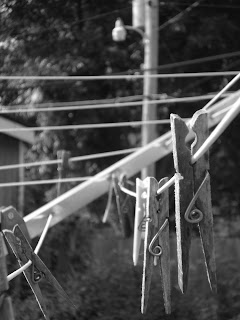
When we moved in to our house a little over six years ago our minds were full of project ideas and new found freedoms. Unlike rental units, in which we had lived for the majority of our adult lives (and for me, most of my whole life), the house afforded us opportunities to express ourselves: wall colors, landscaping and custom alterations. But our first project was a cheap (less than $80) addition that we both felt strongly about: the installation of a clothesline.

Both my husband and myself had fond memories of clotheslines from childhood - those technicolor makers of shade and instant fortresses. But we knew that clotheslines provided much more. Specifically, a clothes line is a solar-powered clothes dryer; a backyard stand against pollution and global warming. We chose a telescoping model for two specific reasons: 1) We have a smallish, urban backyard and didn't want the clothesline to significantly hinder how the space could be used while clothes were on the line, and 2) During cold weather and, say, lawn parties, the pole can be removed from the base, leaving only a small concrete patch flush with the ground. Our particular model can hold about three loads of laundry at a time and was a cinch to install - just one bag of concrete mix and a concrete form was needed.

The benefits of drying your clothes on a clothesline are many.

  • It's free! Drying clothes in a dryer costs on average about 30 cents per load.

  • Environmentally friendly bleach alternative! The sun's rays are quite effective at removing stains. Granted, they can also fade a favorite shirt so drying certain items wrong-side out is recommended. If your clothesline is in a shady area you won't have this concern.

  • Community-building! I cannot tell you how many times I've gotten caught up on the neighborhood scoop while out at the clothesline. Folks lean over the fence to chat when you have a clothesline.

  • Meditation! Hanging clothes up on a clothesline and taking them down are examples of the types of mindless tasks that let your spirit relax.

  • Sunshine fresh! Sun dried clothes smell, well, like sunshine - need I say more?

Of course, there are those naysayers that poo-poo the idea of clotheslines. Here's a few I've heard:

Clotheslines can be such an eye-sore. Isn't it horrible to show your underclothes to the whole world? Well, we make an effort to hang any unmentionables towards the center of our clothes line so that subsequent items block them from view. A three-line long wire clothesline would afford the same option.

Don't the birds poop all over the clothes? Umm, no. For this reason I don't recommend putting your clothesline under a tree, but our current clothesline sits under a power line (aka bird wire) and I'm only aware of one "bomb" in the last six years. The odds are clearly in our favor.


Aren't the clothes wrinkled? The condition of your clothes will only be as good as your technique; if you hang the clothes bunched up and wrinkled then that's how they'll dry. A quick shake and careful pinning and clothes are often removed from the line with less wrinkles than if they sat in the finished dryer for 5 minutes past the buzzer.

But the towels are so stiff and scratchy! True, sun dried towels have a different initial texture than towels slathered in petroleum-derived fabric softeners that were dried in fossil fuel-using dryers. But sun dried towels are more absorbent! Seriously, fabric softeners leave a film on fabric that retards absorption. And that characteristic stiffness is short-lived - as soon as you start using a sun dried towel it begins to soften up.

You're not really saving that much money and energy, so why bother? My family does roughly 4 to 5 loads of laundry per week, which translates into about $1.50 worth of savings per week. No, that doesn't seem like much of a savings. But when you consider that clothes dryers account for an average of 15% of a home's utility usage, you can see how using a clothesline is a cheap and easy way to save a bit of your budget. Plus, if all the homes in the United States used clotheslines exclusively for just 5 months out of the year, imagine the reduction in fossil-fuel based energy demand!


Do you use a clothesline? If yes, what are your favorite things about using one? If not, what's holding you back?


Now, I will be the first to acknowledge that using a clothesline has one serious draw-back: it's seasonal. Like most folks we've used the electric dryer during the colder months, or on a summer day that turned out to be more rainy than sunny. It would be great to have an indoor alternative, especially during the colder months when the drying clothes can add much-need moisture into the air. We've used drying racks inside the house with some success, but their cost ($15 plus dollars each) provides a bit of a set back, since we'd need around 8 of them to dry just one load of laundry. This past winter the husband got creative and hung a sturdy line near the 9 foot tall ceiling of our main living level. It snaked from the dining room through the living room and could hold nearly two loads of laundry (some of you had the pleasure of viewing this oddity). This was a convenient option but a bit of an eyesore at times. And, we had to learn the do's and don'ts of using this type of laundry line (do hang socks in between items to maximize space, don't hang long items in the middle of a walkway).

Does anyone have suggestions on how to tackle this problem? What solutions are available for indoor clothes lines?

Thanks for reading "Rational Living" and providing feedback on this topic. We'll get by with a little help from our friends!

--Rational Mama

Tuesday, August 11, 2009

What is "Rational Living?"

Welcome!

Okay, I am finally starting my journey into the world of blogging. I've been mulling over the idea of this blog for nearly a year, brainstorming topics and debating whether or not to bring it to fruition. But I've had the title pegged from the beginning. So, what exactly is "Rational Living?" Some of you know of my keen interest in WWII homefront rationing and how part of me wants my family to live within those rations for a period of time to see what discipline and self-sacrifice are like. Maybe this blog will someday be about that experience, but for now it's really an amalgam of ideas and doings and changes and discussions. I think the best way to get to the core of this blog is to look at the words themselves.

Ration (noun): a share, especially determined by supply
Ration (verb): to use sparingly

Rational (adjective): having reason or understanding

Living (adjective): having life
Living (noun): means of subsistence
Living (noun): conduct or manner of life

"Ra
tional Living" is about taking only our share and sharing with others. It's about using less so that others have more. "Rational Living" is living within our means and living with meaning, and doing our best to not be driven crazy by the materialistic and consumer-driven expectations of our society. It's about living in a way that mirrors your beliefs which is, in all honesty, really really hard to do. It's not about perfection; I'm not perfect, my family's not perfect and neither are the readers of this blog. It's about real people asking questions and learning from each other and making changes.

Reader participation and feedback are most definitely encouraged.

Some of the common tags you'll see on this blog include sustainable living, gardening, conservation, canning and food preservation, recycling, ethical eating, hunting, petroleum-free, reusing and environmentally-friendly.

Book and movie reviews, recipes and even restaurant recommendations will be included in the content. Let me know if you have a suggestion!

Thanks for reading this and I'd be honored if you followed the blog and became an active commentator on "Rational Living."

--Rational Mama