Been looking at some of the stats for the blog...
Typically, we get an average of 50 page views a day (more if I'm posting regularly, less if I'm taking a break). During months with fresh content we average around 2,000 page views per month.
For the past several months the most-visited archived post is the one about cleaning out the chicken coop. I believe that has to do with a nice Reddit link posted by Anisa at The Lazy Homesteader. There is quite a number of visitors to the post describing when we slaughtered a chicken for the first time, too.
For a good portion of last year a lot of traffic ended up on the post where we caved in to air-conditioning during our rationing summer. Apparently, folks like pictures of the Wicked Witch of the West.
Much traffic comes to the site from searches such as "rationing in WWII" and "1940's women." No surprises there. What I have found very interesting, though, is that searches for "mock apple pie recipe" and "beef heart recipe" regularly appear in the top ten searches that lead people to the site.
Strange, no?
--Rational Mama
Showing posts with label rationing. Show all posts
Showing posts with label rationing. Show all posts
Tuesday, March 20, 2012


Sunday, May 8, 2011
Summer, Post-Rationing
Summer in the plains is officially here.
Today temperature was flirting with 90 degrees, and that's not the heat index. With the muggy air conditions the "feel" of the temperature was definitely in the mid-90s. It brings back memories of last year...
Last year at this time we were sweating it out, literally, as part of our rationing experiment. Trying to stay true to the period, we vowed to do our best to not run the air-conditioner in our house or cars all summer long. This meant frequent cooling showers, lots of fans, and lost sleep due to sticky sheets and misery. Eventually we caved in late June which, surprisingly, was the energy-efficient thing to do.
But this year, we are not rationing (well, unless you call reducing the square footage of your house in half rationing). And tonight near bedtime it was absolutely miserable in the house; temperature near 86 degrees and humidity level over 60%.
So friends, the air-conditioner is now on. And in all honesty it feels really, really wonderful.
--Rational Mama
Today temperature was flirting with 90 degrees, and that's not the heat index. With the muggy air conditions the "feel" of the temperature was definitely in the mid-90s. It brings back memories of last year...
Last year at this time we were sweating it out, literally, as part of our rationing experiment. Trying to stay true to the period, we vowed to do our best to not run the air-conditioner in our house or cars all summer long. This meant frequent cooling showers, lots of fans, and lost sleep due to sticky sheets and misery. Eventually we caved in late June which, surprisingly, was the energy-efficient thing to do.
But this year, we are not rationing (well, unless you call reducing the square footage of your house in half rationing). And tonight near bedtime it was absolutely miserable in the house; temperature near 86 degrees and humidity level over 60%.
So friends, the air-conditioner is now on. And in all honesty it feels really, really wonderful.
--Rational Mama
Friday, December 24, 2010
Rational Top Ten
Can you believe it? Tomorrow is the last day of rationing! Since tomorrow will be filled with family gatherings and festivities we thought we'd highlight what we think are the top ten highlights from the rationing year (in no particular order).
Here goes!
1. Realizing, midway through the first month, that we had been allowing ourselves too many blue/green points. Like, 75% too many.
2. The recipes! Without the rationing project as an excuse there is no way we would have even dreamed of making jellied ham loaf or beef heart kabobs. The historic recipes have encompassed the good (nutburgers, victory pancakes), the bad (six layer dinner, full o'bologney, sausage loaf), and the ugly (hot cabbage slaw and...)
3. Liver. Really, even though it's an historic recipe and could be listed above it deserves a solitary mention. Nothing, nothing, we ate during the rationing year made the same impression as liver. If you've never read this post you really should.
 Oh, thank goodness we didn't have to try this!
4. After a good four or five years of discussion we finally installed an attic (or whole house) fan. This was critical because of our decision to...

5. Sweat it out during the summer by not turning on the air conditioner in the house. It turned out to be one of the hottest summers in the past decade and even with the attic fan and other remedies (cool baths, oscillating fans, popsicles, etc.) we were miserable. Sticking to your sheets and running out of deodorant miserable. Eventually, we caved and turned on the air conditioner. In the end, this was probably the best decision because...
6. We learned that running the attic fan, ceiling fans and oscillating fans along with the dehumidifier used just as much energy as if we had run the air conditioner in the first place. So I guess you could say that sweating it out over a month of summer heat was a miserable but beneficial learning experience.
7. Local fruit. Man oh man, you just can't beat the fresh blackberries, apples, pears, strawberries and mulberries we munched on this summer. And we even have some extra blackberries in the freezer for the long winter months!
8. When a bottle of ketchup costs nearly half of a week's worth of rationing points, nothing says "Suck it, rationing system!" quite like making your own ketchup. Let's face it - ketchup is not a necessity, it's a luxury. Having the ability to make your own (and control the ingredients) is definitely a guilty pleasure. I don't know if we'll ever buy commercially-prepared ketchup again.
9. Having regular commentators from the all across the United States, the U.K. (especially you, Mr. Graham), Eastern Europe, Canada and visits (per traffic reports) from every continent except Antarctica made Rational Living a truly international community. Kinda seems fitting since the real-life scenarios the project was based on included an international community as well.
 10. Even with all the planning required by the rationing project and the huge learning curve experienced in the first few months, no other micro-project during the rationing year was harder that the week we followed U.K. rations. The plan was actually to go two weeks on U.K. rations but the meager servings and food limitations (along with nearly constant hunger complaints from the girls) made us cave at the end of the first week. That week was actually a big turning point for the project, as it really hit home that our voluntary, meager rations (and hunger) were choices for us, whereas plenty on this earth have less than that due to circumstances beyond their control.
And, of course...reader feedback on the blog always made our day. This project wouldn't have been nearly as interesting if we didn't have the helpful and insightful comments from YOU. Thanks for sticking with us through the entire project. This blog will continue on, but we're not quite sure as to the content and form. Stay tuned.
So, are there any other scenarios that we missed that you would have included in a top ten?
--With Love, from the Rational Living family
Here goes!
1. Realizing, midway through the first month, that we had been allowing ourselves too many blue/green points. Like, 75% too many.
2. The recipes! Without the rationing project as an excuse there is no way we would have even dreamed of making jellied ham loaf or beef heart kabobs. The historic recipes have encompassed the good (nutburgers, victory pancakes), the bad (six layer dinner, full o'bologney, sausage loaf), and the ugly (hot cabbage slaw and...)
3. Liver. Really, even though it's an historic recipe and could be listed above it deserves a solitary mention. Nothing, nothing, we ate during the rationing year made the same impression as liver. If you've never read this post you really should.
 Oh, thank goodness we didn't have to try this!
5. Sweat it out during the summer by not turning on the air conditioner in the house. It turned out to be one of the hottest summers in the past decade and even with the attic fan and other remedies (cool baths, oscillating fans, popsicles, etc.) we were miserable. Sticking to your sheets and running out of deodorant miserable. Eventually, we caved and turned on the air conditioner. In the end, this was probably the best decision because...
6. We learned that running the attic fan, ceiling fans and oscillating fans along with the dehumidifier used just as much energy as if we had run the air conditioner in the first place. So I guess you could say that sweating it out over a month of summer heat was a miserable but beneficial learning experience.
7. Local fruit. Man oh man, you just can't beat the fresh blackberries, apples, pears, strawberries and mulberries we munched on this summer. And we even have some extra blackberries in the freezer for the long winter months!
8. When a bottle of ketchup costs nearly half of a week's worth of rationing points, nothing says "Suck it, rationing system!" quite like making your own ketchup. Let's face it - ketchup is not a necessity, it's a luxury. Having the ability to make your own (and control the ingredients) is definitely a guilty pleasure. I don't know if we'll ever buy commercially-prepared ketchup again.
9. Having regular commentators from the all across the United States, the U.K. (especially you, Mr. Graham), Eastern Europe, Canada and visits (per traffic reports) from every continent except Antarctica made Rational Living a truly international community. Kinda seems fitting since the real-life scenarios the project was based on included an international community as well.
 10. Even with all the planning required by the rationing project and the huge learning curve experienced in the first few months, no other micro-project during the rationing year was harder that the week we followed U.K. rations. The plan was actually to go two weeks on U.K. rations but the meager servings and food limitations (along with nearly constant hunger complaints from the girls) made us cave at the end of the first week. That week was actually a big turning point for the project, as it really hit home that our voluntary, meager rations (and hunger) were choices for us, whereas plenty on this earth have less than that due to circumstances beyond their control.
And, of course...reader feedback on the blog always made our day. This project wouldn't have been nearly as interesting if we didn't have the helpful and insightful comments from YOU. Thanks for sticking with us through the entire project. This blog will continue on, but we're not quite sure as to the content and form. Stay tuned.
So, are there any other scenarios that we missed that you would have included in a top ten?
--With Love, from the Rational Living family
Wednesday, December 22, 2010
Review: Meat Me on Rationing Day
 Friends, this may be the most controversial post in the long string of posts that is Rational Living.
Eating is, after all, one of the most intimate things we can do - both individually and as a group. People wax poetic over a fine meal, determine a grandmother's worth based upon her bread rolls and will defend the merits of a traditional menu until blue in the face.
We love to eat and we eat to show love. And Americans love meat.
Meat rationing was the most despised aspect of rationing during WWII. As outlined in the original "Meat Me on Rationing Day" post, red point rationing was designed to encourage Americans to eat less meat and, most importantly, to eat lower grades of meat. But Americans then, as now, loved their meat and governmental restrictions regarding meat purchases were met with great displeasure. During WWII, when Americans were polled as to which rationed products were hardest to cut down on or do without, the overwhelming response was meat (sugar was second, but with a considerably less enthusiastic response). Despite the War, Americans still wanted their steak and pot roast dinners. As a result, meat (particularly higher grade cuts of beef) was a popular black market item.
Flash forward over 60 years and you have our family starting our own year of rationing. At the beginning of the rationing year we already ate less meat as compared to the general American public; prior to the project meat was featured in dinners roughly three to four times a week and showed up in about half of the adult lunches). As such, meat restrictions as a result of rationing weren't felt as keenly by us as they may have been for other families. What meat shortages we did face were usually the result of market fluctuations or our self-imposed inclusion of poultry in the rationing program.
That said, we like our meat. Chicken, bacon, pork chops...we all have a strong appreciation for meat.
Which is why it's quite surprising that, at the conclusion of the rationing project we find ourselves a household of vegetarians.
Yes, you read that correctly. It wasn't the jellied ham loaf or the heart kabobs that turned us, it was the environmental and ethical consequences of animal farming.
One of the catalysts for the rationing project was a desire to live a more environmentally conscious and sustainable lifestyle. In one aspect, the rationing year has been an attempt to move beyond the "easy" practices of recycling and line-drying clothes and to dig deeper into ingrained practices and habits that need changing. Our goal was to find changes that could and should be made to reduce our carbon footprint and create a lifestyle that has a less harmful effect on people and the planet.
With that desire in mind, the hard reality is that factory farmed meat is the diametrical opposite of a sustainable practice. The waste runoff, habitat destruction and pollution caused by animal farming contributes more to global climate change than transportation. Think about it: meat production causes more environmental damage than all cars, planes, trains and boats combined - a whopping 40% more. A hybrid car is a great thing, but if your driving it to the local burger joint your doing more damage than you probably realize.
And then there's the ethics of meat production. Factory animal farming is notorious for using (and abusing) undocumented workers - creating workplace environments that constitute human rights violations. Meat processing at break-neck speeds endangers both the workers (meat processors have the highest on-the-job injury rate of any labor field) and endangers the public - E. coli outbreaks are the result of unsanitary practices resulting from factory processing (those bleach baths the meat takes before packaging don't kill everything). Cheap labor and fast processing promotes lower meat prices, but at a cost to humanitarian and health well-being.
Then, of course, there's the animals. I won't go in to the horrors of factory animal farming - there are plenty of available resources to educate you on that topic. And even if you make the commitment to purchase the more expensive, locally-raised meat there is still the slaughter to consider. Because most local slaughter facilities have been purchased ("bought out") by the large CAFO companies the likelihood that even your free-range, humanely treated animals experience a human slaughter is extremely slim.

So the only way for us to feel at peace with eating meat is to make sure the animals are treated respectfully during life and ensure that they had a humane slaughter. In the current system, the only way to guarantee both of those assertions is to have a direct part in both the raising and processing of the animal.
TMOTH and I both have strong opinions about having honest relationships with food: know what it is, where it came from and what it went through to be on your plate. This goes for meat, too, and is why when TMOTH hunts he only attempts a shot that is clear and direct and will cause the least suffering for the animal. It is also the reason why we process the venison ourselves.
But really, why should other meat be treated any differently?
Our new homestead will allow us, for the first time ever, the ability to raise our own animals for meat purposes. Whether we have the fortitude to raise an animal in an intimate setting and then slaughter it for food has yet to be determined. But know this about our beliefs: if we can't raise and slaughter it ourselves, then we shouldn't be eating it. Period.
And even the girls support this transition; even Sissy, the biggest carnivore of the family, has learned enough about factory animal farming to support this decision with maturity and understanding.
We know many, many readers will not agree with this choice. We're not telling you that you should be living by these same standards or judging your practices or insisting that our beliefs are better than yours.
We're just trying to live by our standards of what is right...and encourage you to live by your own.
--Rational Mama
P.S. For a thorough, even-handed examination of the implications of animal farming and eating meat, I highly recommend Jonathan Safran Foer's, "Eating Animals."
Monday, December 20, 2010
Review: Of Veg and Cheese...and Java Dilemma
 In the original "Of Veg and Cheese" post I outlined how, in accordance with life in the early 1940's, we would be limited to seasonably available produce during the rationing year, with the exception of canned and frozen produce which would be subject to ration points and market fluctuations.
So how did it go?
Well, last winter was tough - no bones about it. With just one pound of frozen vegetables setting us back one quarter of our weekly blue/green points, we were forced to work with seasonally available produce. This meant mostly carrots, potatoes and cabbage. And trust me, with all other green, leafy vegetables unavailable you start to appreciate cabbage on a whole new level.
Going without fresh salad for a few months definitely helped us understand how much we really love salad, even if it's as basic as a few green leaves and a simple dressing. Luckily, growing lettuce and mesclun indoors (or in a hoop frame or cold frame) is so easy we were able to get a jump start on our spring greens.
Once early summer came around we had locally grown produce available from our gardens, the farmer's market and our CSA bag. As you know, we had a hard time maintaining our Victory Gardens, and my new work schedule made visiting the farmer's market logistically tricky. And for a second year the CSA bags were a bit of a disappointment (some of the produce was actually of poor quality); I don't believe we'll do CSA bags in the future.
On the other hand, you just can't beat locally grown fruit. This past year we consumed our share of local strawberries, blackberries, apples and pears. Nothing can beat a fruit that was allowed to ripen fully before picking...and then immediately eating it. Really, I cannot downplay the physical and sensual joy of experiencing a local "u-pick" establishment.
As far as cheese goes...well, it's a staple we never want missing from the fridge. The versatility of hard cheese (snack, recipe ingredient, sandwich topper) make it a very useful, albeit rationed, resource. And thank goodness sour cream and cottage cheese weren't rationed - they have frequently been used to bulk up a sauce or soup (the former) or add protein to an otherwise light meal (the latter).

And finally, coffee. As outlined in the post "Java Dilemma," during rationing each adult received one pound of coffee every five weeks, assuming shortages didn't throw a kink into your coffee purchasing week. Both TMOTH and I increased our coffee consumption during the past year, in exchange for shrinking our soda intake. Even with that change, though, we were never in danger of running out of coffee supplies before the next ration amount could be purchased. We even had enough of a coffee surplus to, umm, be creative.
So, what of veg and cheese and coffee after rationing? We plan to continue focusing on seasonably available produce in an effort to reduce the carbon footprint of the fruits and vegetables we eat. And we'll continue to drink coffee at our current rates and avoid heavily-sugared sodas.
And cabbage...dear, sweet cabbage. You will always have a special place in our hearts...even if you're not as frequent a visitor at the table.
--Rational Mama
Thursday, December 9, 2010
Homestretch
349 days in and only 16 more days to go.
We're actually going to pull this off, huh?
--Rational Mama
We're actually going to pull this off, huh?
--Rational Mama
Wednesday, December 8, 2010
Review: Rationing: The Not-So-Sweet Life?
When writing the original Rationing: The Not-So-Sweet Life? post I bragged that our household limitation of 8 pounds of sugar per month "doesn't seem that daunting to me." Even without the availability of prepackaged sweets and cookie dough from a tube I felt that this was one ration that was completely manageable.

And you know what? I was right.
Maybe it's because our family doesn't keep a cookie jar regularly supplied, as was the norm in the 1940s. Or maybe we ate fewer sweets. Either way, we adapted quite well to the the sugar restrictions. Cookie craving? Better get the recipe book out because you're not getting any unless you put in the effort. And there were several nights when I would have loved a warm, gooey cookie straight from the oven but was too lazy to actually do the work. And that's probably a good thing.

Granted, I did buy the girls Twinkies at one point, since they are a treat that is historically accurate (well, at least in form - I'm not sure if all the same preservatives and artificial colors were used in the past). The girls loved them.
Otherwise, I could go several weeks without claiming our sugar rations and still have plenty available on the shelf. The only time I had to be careful and make sure we had a copious supply was during the summer canning season.
One thing we did fail at was the interest in buying mostly sustainably-grown sugar. That will be something to consider while we make plans for life after rationing.
--Rational Mama
Friday, December 3, 2010
Review: Rationing is a Gas! Gas! Gas!
 One of the first posts about the rationing year project concerned gasoline and mileage rationing. In it, we described how gasoline was rationed during WWII and the issues we were wrestling with in trying to come to some sort of modern equivalent. In the end, we came up with a self-imposed mileage ration of 193 miles per week combined for our two vehicles.
So...how's it been? Well, once we project out an average weekly mileage for the last few weeks of rationing (plus the mileage for a holiday round trip visit to Wichita) and add it to our already documented mileage we will have traveled (in our personal vehicles) roughly 10,007 miles during the rationing year, which is just slightly under the total miles of 10,036 allotted to us during rationing (193 miles per week x 52 weeks).
We're all pretty happy that we stayed within our limit and didn't fall into the trap of going farther (literally) even though we knew there wouldn't be any real consequences for us if we did go over our rationed amount.
 In order to stay within our ration we definitely had to be mindful about how and when we were driving. We became pros at combining/consolidating trips and had to be extra careful with miles when the girls had out-of-town swim meets every other week during the summer. Our "vacations" consisted of two short getaways to Kansas City and one trip to Wichita to see family. Our mileage allowance did not permit a more grand vacation even if we incorporated some carpooling and I occasionally walked to work.
And to be honest, we were all feeling the lack of big getaway by the time autumn arrived.
As a family we have to decide how we will handle mileage after rationing is over. All of us agreed that we didn't want to remove mileage off the radar completely, especially once we reviewed the math.
During the rationing year our 10,000 miles were considerably below the national average; the average adult American drives 12,000 miles per year, which means the average for a two-driver household like ours is 24,000 miles per year. By following our rationing limits we drove 14,000 miles less than a comparable family.
Fourteen thousand less miles means fewer gallons of gasoline (and more money in our pocket). Using a very modest estimate of 20 miles per gallon, 14,000 miles equates to 700 less gallons of gasoline. Each gallon of gasoline creates 20 pounds of carbon dioxide, so by travelling 14,000 miles (or 700 gallons of gasoline) less than the average two-driver household we avoided dumping 14,000 pounds of carbon dioxide into the air.
That's seven tons, or the equivalent of 1,400 10lb bags of potatoes, or roughly four mini-vans! After that kind of a realization, we can't just abandon mileage/gasoline rationing completely.
That's seven tons, or the equivalent of 1,400 10lb bags of potatoes, or roughly four mini-vans! After that kind of a realization, we can't just abandon mileage/gasoline rationing completely.
So we've decided to keep tracking our mileage but give our family a slightly higher allowance so that more frequent weekend trips and a decent vacation (likely to involve driving) can be incorporated. We are also aware that we will likely be using more miles next year for basic errands (more on that development in a later post). Taking all these things into consideration we have decided that our new, post-rationing family limit for mileage will be 15,000 miles combined for the year. This gives use a weekly allowance of 288 miles - nearly 100 miles more per week than during rationing! The trick will be to not squander those miles but to save them up for the fun stuff.
Pondering all those extra miles and the possibilities seems like a luxury. Where will we go first?
--Rational Mama
Monday, November 29, 2010
T-Minus 26 Days and Counting
Can you believe it? We have less than a month left of rationing! The end is near!
This is traditionally a very busy time of year for us; between Thanksgiving and the middle of January we have four family birthdays, three holidays and two birthdays of very dear friends. Plus, this year we're dealing with trying to decide what life will look like after rationing and all of the house stuff. Luckily, by now we're whizzes when it comes to rationing and it doesn't take much brain power to come up with a ration-friendly menu and point total.
As a result we will be ending the month of November with a surplus of 95 red and 45 blue/green points (!).
In the meantime, thanks for sticking with us!
Tuesday, November 9, 2010
A Light in the Darkness
 What is a rationing mother to do when the family must be fed, she doesn't want to cook anything complicated and the rest of the clan wants something tasty now?
Easy, relatively quick and everyone is happy! Yay for SPAM!
--Rational Mama
Sunday, November 7, 2010
Television Daze
Sometimes it's really challenging to be patient - especially in today's day and age. I can get takeout ordered and delivered, check out the game score and view the week's forecast all within half an hour and all without leaving my house. Patience may be a virtue, but today it seems a seldom-needed virtue.

 So that's how I was able to say no to the television temptation. I was thinking about appliance rationing and delayed gratification and such. If you combine our Internet/television usage time I believe it roughly equates to what would have been the average usage of telephones and radios in the 1940s (and they serve the same purposes). If a new radio wasn't an option for 1940s rationers then a new television shouldn't be available to us during our rationing year.
And we typically don't like it when we're asked to use it.
Take, for example, our most recent appliance dilemma. Our current TV (yes, we only have one in the house - I believe this makes us an anomaly in the U.S. for our family size and income bracket) is roughly seven years old. It's a standard early 2000's model and after years of use and abuse the remote has gone AWOL. Also, it doesn't have a digital tuner and, considering how much cabinet space it takes up, it doesn't provide the nice wide screen features of the newer flat-screen models.
Additionally, it apparently has Seasonal Affective Disorder.

For the past several years the speakers have not worked properly during the colder months. It took us a few seasons to realize what was going on, but during the colder months the speakers rattle with noises of specific frequencies (think mumbling dialogue, car chases or an awesome Viper/Raider fight sequence from, say, Battlestar Galactica). Understandably, this can be quite irritating.
But then spring comes and temperatures warm up and we forget about the speaker plague of the previous four months. We tolerate the display even if we can't see the far edges and labels of the PBS program we're watching.
Oh, and we continue to pay around $12 per month to get our local affiliates (plus a handful of ot her channels that we don't really watch) since we lack the digital tuner.
Well, we are finally ready to purchase a new TV! All modern with a wide screen, working remote, digital tuner and functional speakers! We've been doing the research and it seems like our best fit would be a 32" LCD HDTV with 1080p and 120 Hz. The girls and I were in the area of the big box electronic store today so we stopped in to browse.
I had been estimating about $600 for our future purchase, based on prices from a few months ago. I had heard rumors that the prices on LCD televisions were dropping because of a glut of inventory (bad economy = slow electronic purchases). Wow - those rumors are true! I found a model with the exact features we're looking for with a high customer rating on mega-sale for only $450! Plus, with my credit and such we could do eighteen months of interest free financing.
Oh man...the temptation was there! How was I able to walk out of that store without a television?
Because appliances were rationed during WWII. Remember our oven range dilemma? We were in a pickle because ranges were in short supply during the war (not very many were being produced in the war-driven factories) so families in need of a range had to apply for one. If they were turned down then they either had to find a used model or make do without one.
 So that's how I was able to say no to the television temptation. I was thinking about appliance rationing and delayed gratification and such. If you combine our Internet/television usage time I believe it roughly equates to what would have been the average usage of telephones and radios in the 1940s (and they serve the same purposes). If a new radio wasn't an option for 1940s rationers then a new television shouldn't be available to us during our rationing year.
But then I came home and did a little research. Apparently, I over-estimated the variety of appliances and such that were rationed during WWII. True, oven ranges were available only through an application process - as were automobiles, bicycles and typewriters. But that was the extent of appliance rationing. It doesn't take much effort to find War-era advertisements for new radios via Google. This all makes sense considering how much the government used radio as a tool for morale and support during the War.
So...what to do?
--Rational Mama
Wednesday, October 27, 2010
Blog? There's a Blog?
Oh, hi.
Hello blog visitor. It's nice to have you visit. I promise we haven't ditched the blog. Really, really promise.
We're still rationing our little hearts away, but just very busy with all the crazy fall stuff that covers us in an avalanche of responsibilities every October: homework projects, Halloween costumes, parties, school conferences, etc.
I'm hoping to get some new content up in the next week or so - a few historic recipes and insights now that we're down to just two months (*gasp*) left of the rationing project.
Oh, dear...that means there's less than two months until Christmas. Yeah, things are going to get even busier around here.
But the blog shall not suffer!
After all, we wouldn't want to disappoint the fabulous readers that have made this journey so interesting and fun. Did you know that an average of 35 to 40 visitors come to the blog each day? No? How 'bout this: the blog averages around 50 page views a day.
Not too long ago the blog had almost 100 page views in a single day.
That just blows my mind. Really. When we started this project and the blog we were hoping that maybe a few (mostly) local folks would join in and provide commentary, questions and insights. Instead, the blog has had over 5,500 visitors and is edging towards 9,000 page views. Visitors have come from all six permanently inhabited continents. How crazy is that?
I can only hope that the next two months (and beyond) will be as thought-provoking and worthy of your attention.
And maybe ya'll can help suggest to us what our life should be like after rationing. Because, frankly, it all looks a bit overwhelming from down here in the trenches.
So grab a chair and a beverage, let us know where you are and what you would do after rationing if you were us.
--Rational Mama
Hello blog visitor. It's nice to have you visit. I promise we haven't ditched the blog. Really, really promise.
We're still rationing our little hearts away, but just very busy with all the crazy fall stuff that covers us in an avalanche of responsibilities every October: homework projects, Halloween costumes, parties, school conferences, etc.
I'm hoping to get some new content up in the next week or so - a few historic recipes and
 insights now that we're down to just two months (*gasp*) left of the rationing project.
Oh, dear...that means there's less than two months until Christmas. Yeah, things are going to get even busier around here.
But the blog shall not suffer!
After all, we wouldn't want to disappoint the fabulous readers that have made this journey so interesting and fun. Did you know that an average of 35 to 40 visitors come to the blog each day? No? How 'bout this: the blog averages around 50 page views a day.
Not too long ago the blog had almost 100 page views in a single day.
That just blows my mind. Really. When we started this project and the blog we were hoping that maybe a few (mostly) local folks would join in and provide commentary, questions and insights. Instead, the blog has had over 5,500 visitors and is edging towards 9,000 page views. Visitors have come from all six permanently inhabited continents. How crazy is that?
I can only hope that the next two months (and beyond) will be as thought-provoking and worthy of your attention.
And maybe ya'll can help suggest to us what our life should be like after rationing. Because, frankly, it all looks a bit overwhelming from down here in the trenches.
So grab a chair and a beverage, let us know where you are and what you would do after rationing if you were us.
--Rational Mama
Sunday, October 17, 2010
Pledge of the American Housewife
It's been just over a year since we posted the first entry about the rationing project, and our year-long journey will be over in roughly two months and some change. It's time to start thinking about life after rationing.
What do we keep? What do we throw aside? What changes stick and what changes slide away?
We are certain that we want to continuing eating a healthy, ethical diet. What this means has yet to be determined.
In the last post I grumbled about life after rationing c. 1940s. But, as I mentioned, there was a determined group of individuals who encourage Americans to avoid gluttony so that others in poverty abroad could receive our exports. The Famine Emergency Committee put together a pledge to solidify promises against food waste, and it seems like a good place to start for our own post-rationing ideas:
"This is my sincere and voluntary pledge to assist in saving the lives of millions of starvation victims throughout the world."
What do we keep? What do we throw aside? What changes stick and what changes slide away?
We are certain that we want to continuing eating a healthy, ethical diet. What this means has yet to be determined.
In the last post I grumbled about life after rationing c. 1940s. But, as I mentioned, there was a determined group of individuals who encourage Americans to avoid gluttony so that others in poverty abroad could receive our exports. The Famine Emergency Committee put together a pledge to solidify promises against food waste, and it seems like a good place to start for our own post-rationing ideas:
"This is my sincere and voluntary pledge to assist in saving the lives of millions of starvation victims throughout the world."
1. I will do my utmost to conserve any and all foodstuffs which the starving millions of the world need today so desperately.
2. I will buy only the food my family actually needs for its proper nourishment and health.
3. I will neither waste nor hoard...nor discard any article of food...in cooking or in serving...and will ask my family for the fullest possible cooperation.
4. I will be particularly watchful in the use of wheat and cereals...and fats and oils...and will try to make certain that not a scrap of bread is wasted in my home.
5. I will make these little sacrifices gladly...for the sake of those who cannot enjoy my God-given right to live...and give...as an American. [ellipses in original]
How many of us buy that extra bag of lettuce or fruit "just in case" and then watch it rot before it has a chance to be consumed? Or let containers of leftovers mold in the fridge while we do take-out instead?
These are the kinds of things we'll be pondering as we think about life after December 25, 2010.
--Rational Mama
How many of us buy that extra bag of lettuce or fruit "just in case" and then watch it rot before it has a chance to be consumed? Or let containers of leftovers mold in the fridge while we do take-out instead?
These are the kinds of things we'll be pondering as we think about life after December 25, 2010.
--Rational Mama
Friday, October 15, 2010
Dropping the Ball
 It's been one week since we prematurely ended the U.K. ration portion of our experiment. I've been doing a lot of soul searching since then.
Don't worry; we're still following our U.S. rationing guidelines. It was very easy to fall back into that groove: red points, blue points, etc.
But it feels different this time.
You see, living on U.K. rations was nothing less than hard: each day I had to carefully manage our limited supplies - what fat was available, what would do for breakfasts, and what pantry items were of adequate supply to provide enough dinner for four. The girls were hungry; we were all hungry.
I imagine that, historically, the hardship might have been more manageable if the entire country could commiserate with the shortages and make-do recipes and the hunger (in-between air raids, that is).
But in the U.S. things were different. Sure, there were shortages and occasional items were missing from the shelves. But what has become apparent from this (now over nine month) experience is that U.S. rations during WWII were generous compared to our own Allies across the pond. There was enough that the U.S. could help supplement British diets with exports of canned meat, fruit and vegetables. This was because U.S. food production (both private and commercial) skyrocketed during the War. Between Victory Gardens and factories running 24/7 the availability and variety of foods in America during the War made the grocery store shelves in the U.S. look like technicolor versions of heaven to the impoverished abroad.
And at least during this part of the War Americans had their heads and hearts in the right place: in a 1943 poll 62% of American respondents thought that continued rationing after the War would be necessary for a year or two to better control shortages and continue supplying war-torn nations with much needed food. By 1944 that number had risen to 85%; images of starving children in Europe and Asia were finding their way into U.S. media and it was hard to argue with such evidence. In 1945 individuals in Tokyo were getting only half of their official ration allowances (520 calories a day); at the same time over 70% of Americans thought it in the country's best interest to help overseas after the War.
And then something happened: the War actually ended.
As of August 15, 1945 (the day after V-J Day), rationing in the U.S. was over. History. Tired of the cumulative deprivation that was the Great Depression and WWII, Americans were happy to once again experience a lifestyle of abundance and leisure.
By March of 1946 only 59% of Americans favorite a return to rationing in order to send food to the needy in other nations (and that number dropped even further if the receiving nation was in Asia). Persuaded by the manufacturing and farm lobbyists, most Americans began to believe that advances in science and technology would be the way to rescue the international community out of poverty.
Granted, there was a group of citizens and activists that were not happy with this complacency towards the hungry. Pressure from voters and cabinet members lead President Truman to hastily create the Famine Emergency Committee in the spring of 1946. The FEC emphasized the notion that no other country, aside from Canada, could provide the food needed to rescue the rest of the world from starvation. To accomplish this they recommended that Americans return to rationing. When it became clear that neither industry nor the government was interested that option, the FEC recommended that Americans reduce their wheat consumption by 40% and their usage of fats/oils by 20%.

The response was underwhelming. In a 1947 Gallup Poll only 22% said they followed the government's suggestion of meatless Tuesdays (although 38% said they were planning to follow it). Roughly 29% of respondents replied that eating no meat on Tuesdays was "too difficult." Meanwhile, photos of the food wastage transpiring in the U.S. did little to gain sympathy from world communities that were continuing to suffer from drought conditions and the effects of war.
I know what you (the Americans) are thinking: what about the Marshall Plan? We all learned about the wonders of the Marshall Plan in our high school history classes; how it helped build up Europe after the War and created an efficient, sustainable infrastructure. But do you remember that the Marshall Plan wasn't enacted until 1948 - a full three years after WWII ended? And that only 29% of the multi-billion dollar program went to supply food, feed and fertilizers? The rest was spent on factories, buildings, and roads. And since food supplies were tied with politics, the amount of aid sent to Asian countries during this time period was but a small sliver of the amount sent to Europe.
So what am I trying to say? I'm saying that the U.S. blew it. Dropped the ball 100%. We had the chance to raise millions of lives out of poverty (and even prevent innocent deaths), but in the end we chose a nice steak dinner and chocolate cake rather than subject ourselves to modest, manageable rationing program.
And in reality, things really aren't that different today. The U.S., along with Canada, has the fields, the factories and the transportation needed to provide poverty relief both locally and around the globe.
So when this modern mother had to listen to her children's' repeated requests for food because they were genuinely hungry (and not just bored), it was a wake up call. What was a choice for me (living on restricted rations) is someone else's reality. Today.
According to the World Health Organization, approximately one-third of the world is well fed, one-third of the world is underfed, and one-third of the world is starving. Today.
Meanwhile, incidents of childhood and adult obesity in the U.S. are skyrocketing.
The system is broken. I'm not saying that it's an easy fix, or that it will ever be perfect. But something has to be done - locally and internationally.
And you know what? I'm not going to be the one to drop the ball this time.
--Rational Mama
Tuesday, October 5, 2010
Of Pie, Hunger and Nachos
 There is so much I want to tell you about living on 1945 U.K. rations.
I want to tell you that with all the limitations and restrictions menu planning gets tricky fast. Our weekly menu for the first week of U.K. rations included:
Friday: Vegetable-Garbanzo Soup with Dumplings
Saturday: Dinner at Friends' House (previous engagement)
Sunday: Roasted Chicken, Mashed Potatoes, Fresh Green Beans, Grilled Zucchini and Gravy
Monday: Woolton Pie
Tuesday: Spaghetti Noodles and Homemade Cheese Sauce
Wednesday: Chicken and Dumplings (using the chicken carcass from Sunday)
Thursday: Stir-fried Vegetables and Eggs with Rice
I want to tell you how all these restrictions make for very brief and focused shopping excursions.
I want to tell you that for breakfasts we've been eating yogurt (not rationed but available) and toasted oats and/or oatmeal. On Monday morning I made a batch of (reduced butter and sugar) cinnamon rolls for a special treat, and to literally butter up the girls for the Woolton Pie that evening. For lunches TMOTH and I have been eating leftovers and skimpy chicken sandwiches using leftover meat from Sunday and our very modest mayonnaise rations. We've been keeping the girls' lunches solid (peanut butter and honey sandwiches, crackers, local fruit) since during the War they would have had additional lunch options at school.
I want to tell you that snacking is severely limited on U.K. rations. The general rule is that if you didn't make it then it's not available, and your supplies are almost too tight to make anything. On Sunday I made a homemade granola bar type concoction that was snacked on for several days. Otherwise, snacking has been mostly limited to carrots and the local apples/pears we picked last month.
I want to tell you that I wouldn't want to be on these rations in the dead of winter, with few fresh vegetables available.
I want to tell you that I was finding the transition from one cup of coffee per day to one cup of tea per day very difficult.
I want to tell you that the results of the Woolton Pie were very predictable (Eowyn loved it, Sissy loathed it).
I want to tell you that the soap rations haven't been too terrible and that we managed to stay under our 157 allotted miles for the week.
I want to tell you how hungry we've been. Nearly every night we've needed an evening snack for the girls, and usually for the adults as well. One night we popped popcorn, but had to use lard since the butter and margarine were reserved for other purposes. Another night we made carrot cookies (surprisingly good).
I want to tell you that I was looking forward to making bangers and mash and sharing with you next week's menu and how I "spent" our points...but I don't have to.
Last night, after a very busy day AND night, TMOTH and I found ourselves driving home alone.
"I'm hungry," TMOTH said quietly.
"Me, too." I replied.
I thought about how many times the four of us had said those words over the past six days. I'd heard it from the girls more than once each day we'd been on U.K. rations. I thought about hearing it for another eight days.
And then I said, "Maybe six days is enough."
We had learned our lesson. What the civilians of the United Kingdom dealt with was far beyond the situation handed to the Americans. As Sissy put it, "They [in the U.K.] had only what was needed, but in the U.S. we could also get things we wanted." And that doesn't even include the air raids.
So I want to tell you how last evening we picked the girls up from their grandparents and told them that we were done with U.K. rations. They cheered. They were actually happy to be back on U.S. rations.
And then they told us they were hungry. We all agreed that we wanted cheese. Lots of cheese.
So we went home and had nachos for a bedtime snack.
--Rational Mama
Monday, October 4, 2010
Ribena = Crack
I'm not sure what the general opinion of Ribena is across the pond, but I can tell you that in the Rational Living household Ribena is now a legendary favorite.
Let me provide some background for those state-side readers.
When I was preparing for our two weeks of U.K. rations, I asked Mr. Graham (from On the Ration) if the 4 oz of loose tea per person was per adult only, or if children also received a tea ration. His response: "Your tea is per adult - the children get Ribena squash (blackcurrent cordial) instead."
Now, in the U.S. the term "cordial" is most frequently refers to thick, sweet alcoholic beverages...hence, I thought he was being silly by suggesting that the adults receive tea rations and the children get booze. But, thanks to my friend Google I was set straight.
Ribena is, in fact, a concentrated blackcurrant syrup that is then diluted with water to produce a juice-like beverage. During the War its high vitamin C content helped make it a popular nutritional aid for children in the U.K. (it's true vitamin C content has come under attack in recent years).
 I felt very fortunate to find bottles of Ribena at our local grocery store in the "British" section. What else is in the "British" section? Some biscuits, cans of spotted dick (giggle) and those most definitely non-American cans of Heinz beans in tomato sauce. There are some other items as well which, I imagine, the store's ordering manager consider "classically British." Teas, jams, and candies.
Anyhoo...back to Ribena...this stuff is good. It's like liquid candy - or something even more addictive. When I called the girls into the kitchen to try some they were a bit skeptical - with it's dark color I think they thought it would taste like that hideous cough syrup. After a quick taste they promptly downed their glasses and loudly proclaimed that we should buy Ribena even when we aren't rationing. It's good enough that TMOTH and I have found ourselves making small glasses of the stuff for ourselves (shhh! don't tell the girls). Maybe a bottle of Ribena will make it into the girls' Christmas stockings this year...
Oh! Another gem I found in the "British" section was gravy granules. If you're a regular reader of On the Ration then you're familiar with Mr. Graham's semi-frequent mention of gravy granules. We have no such product here in the U.S. - our instant gravy items are typically powdered and consist mostly of corn starch which can (if overused) turn a wonderful gravy base into a brown paste.
I purchased the granules (the label ensures me that the kind I purchased are the "Nation's Favourite Gravy") to use on the gravy I was making with last night's roasted chicken (our special meat purchase for the week). When I first open the package I was alarmed by what appeared to be fish food. Seriously, the granules are gray and look like the pellets used to feed cichlids. Unfortunately, there is no way this product would fly as-is in the U.S. unless it was loaded with artificial dyes. Ugly but true. Anyway, last night I diluted the roast chicken drippings with a little water, added the granules and brought it to a boil. The resulting gravy was a little on the thin side but had a nice flavor and in no way resembled paste. This is all good, since tonight I will use the extra gravy as part of the Woolton Pie I will be making for dinner. Another classic U.K. wartime food, Woolton Pie is a concoction of cooked vegetables, oats and mashed potatoes.
I'm already preparing for Sissy's revolt. Maybe I can appease her with some Ribena?
--Michelle
Let me provide some background for those state-side readers.
When I was preparing for our two weeks of U.K. rations, I asked Mr. Graham (from On the Ration) if the 4 oz of loose tea per person was per adult only, or if children also received a tea ration. His response: "Your tea is per adult - the children get Ribena squash (blackcurrent cordial) instead."
Now, in the U.S. the term "cordial" is most frequently refers to thick, sweet alcoholic beverages...hence, I thought he was being silly by suggesting that the adults receive tea rations and the children get booze. But, thanks to my friend Google I was set straight.
Ribena is, in fact, a concentrated blackcurrant syrup that is then diluted with water to produce a juice-like beverage. During the War its high vitamin C content helped make it a popular nutritional aid for children in the U.K. (it's true vitamin C content has come under attack in recent years).
 I felt very fortunate to find bottles of Ribena at our local grocery store in the "British" section. What else is in the "British" section? Some biscuits, cans of spotted dick (giggle) and those most definitely non-American cans of Heinz beans in tomato sauce. There are some other items as well which, I imagine, the store's ordering manager consider "classically British." Teas, jams, and candies.
Anyhoo...back to Ribena...this stuff is good. It's like liquid candy - or something even more addictive. When I called the girls into the kitchen to try some they were a bit skeptical - with it's dark color I think they thought it would taste like that hideous cough syrup. After a quick taste they promptly downed their glasses and loudly proclaimed that we should buy Ribena even when we aren't rationing. It's good enough that TMOTH and I have found ourselves making small glasses of the stuff for ourselves (shhh! don't tell the girls). Maybe a bottle of Ribena will make it into the girls' Christmas stockings this year...
Oh! Another gem I found in the "British" section was gravy granules. If
 you're a regular reader of On the Ration then you're familiar with Mr. Graham's semi-frequent mention of gravy granules. We have no such product here in the U.S. - our instant gravy items are typically powdered and consist mostly of corn starch which can (if overused) turn a wonderful gravy base into a brown paste.
I purchased the granules (the label ensures me that the kind I purchased are the "Nation's Favourite Gravy") to use on the gravy I was making with last night's roasted chicken (our special meat purchase for the week). When I first open the package I was alarmed by what appeared to be fish food. Seriously, the granules are gray and look like the pellets used to feed cichlids. Unfortunately, there is no way this product would fly as-is in the U.S. unless it was loaded with artificial dyes. Ugly but true.
 Anyway, last night I diluted the roast chicken drippings with a little water, added the granules and brought it to a boil. The resulting gravy was a little on the thin side but had a nice flavor and in no way resembled paste. This is all good, since tonight I will use the extra gravy as part of the Woolton Pie I will be making for dinner. Another classic U.K. wartime food, Woolton Pie is a concoction of cooked vegetables, oats and mashed potatoes.
I'm already preparing for Sissy's revolt. Maybe I can appease her with some Ribena?
--Michelle
Sunday, October 3, 2010
Mabel's Kindness
 Last week we had a supply of apples (some donated) that needed to be made into pies - quickly. I was faced with the dilemma of trying to prepare three pies while simultaneously working full-time, attending war-bond meetings, organizing the next scrap metal drive and providing wholesome, well-rounded meals to my family. What was a rationing mother to do?
Luckily, sweet little Mabel came to the rescue. Gray-haired Mabel lives down the block from us in a dainty white house. Her peonies are always gorgeous and she makes the most delicious caramel popcorn balls for the neighborhood kids at Halloween. Mabel is very active in the war effort, volunteering her time for several community organizations including the Red Cross and her women's church group, which sends care packages oversees to our boys fighting those Nazi monsters.
Behind me I heard Sissy and Eowyn giggle as they ran out to play. Those pie crusts represented an hour of work and several points worth of fat rations. "Mabel," I countered, "This is very generous of you, but..."
How could I say no?
"No thank you, dear," answered Mabel, too proud and honest to accept the trade.
"That sounds like a beautiful plan."
--Rational Mama
Missing Coffee
 Tea does our fancy aid,
Repress those vapours which the head invade
And keeps that palace of the soul serene.
--Edmund Waller (17th century English poet)
Yeah, but coffee does it so much better.
--Rational Mama (21st century rationer)
Saturday, October 2, 2010
(Kinda) Historic Recipe: Dried Apple Skins
While processing all those pounds of pears and apples last week (after a fresh fruit dry spell) it seemed a shame to not get everything we could out of the produce. The cores, unfortunately, don't have much purpose unless you're making apple/pear sauce and/or feeding the pigs. We did neither. The peels, however, have possibility - especially since the apple magic makes such nice, even strips of peel with a little fruit on them to boot.
Determined to not let this resource be wasted, I took a pile of peels, drizzled an ever-so-tiny amount of oil on them and dusted them with cinnamon and sugar. I then tossed them in a bowl to coat evenly. To dry the peels (or anything, for that matter) you can use either an oven or an electric dehydrator. I used both last week and liked the results from the dehydrator better, so I'll pass along those instructions.
Distribute the peels in single layers on dehydrator trays, being sure to not overlap the pieces too frequently. Set the temperature to 135 degrees and let the dehydrator run for five hours or so (time will depend on how much moisture is present in the peels).
Most electric ovens will only go as low as 175 degrees, so if you use the oven watch the peels carefully so that they don't burn.
Time permitting, we might make some applesauce next week and put all the apple to good use. We love applesauce but it is not allowed on UK rations and on US rations it basically costs one blue/green ration point per once. With only 48 blue/green points per week it's quite a luxury!
Determined to not let this resource be wasted, I took a pile of peels, drizzled an ever-so-tiny amount of oil on them and dusted them with cinnamon and sugar. I then tossed them in a bowl to coat evenly.
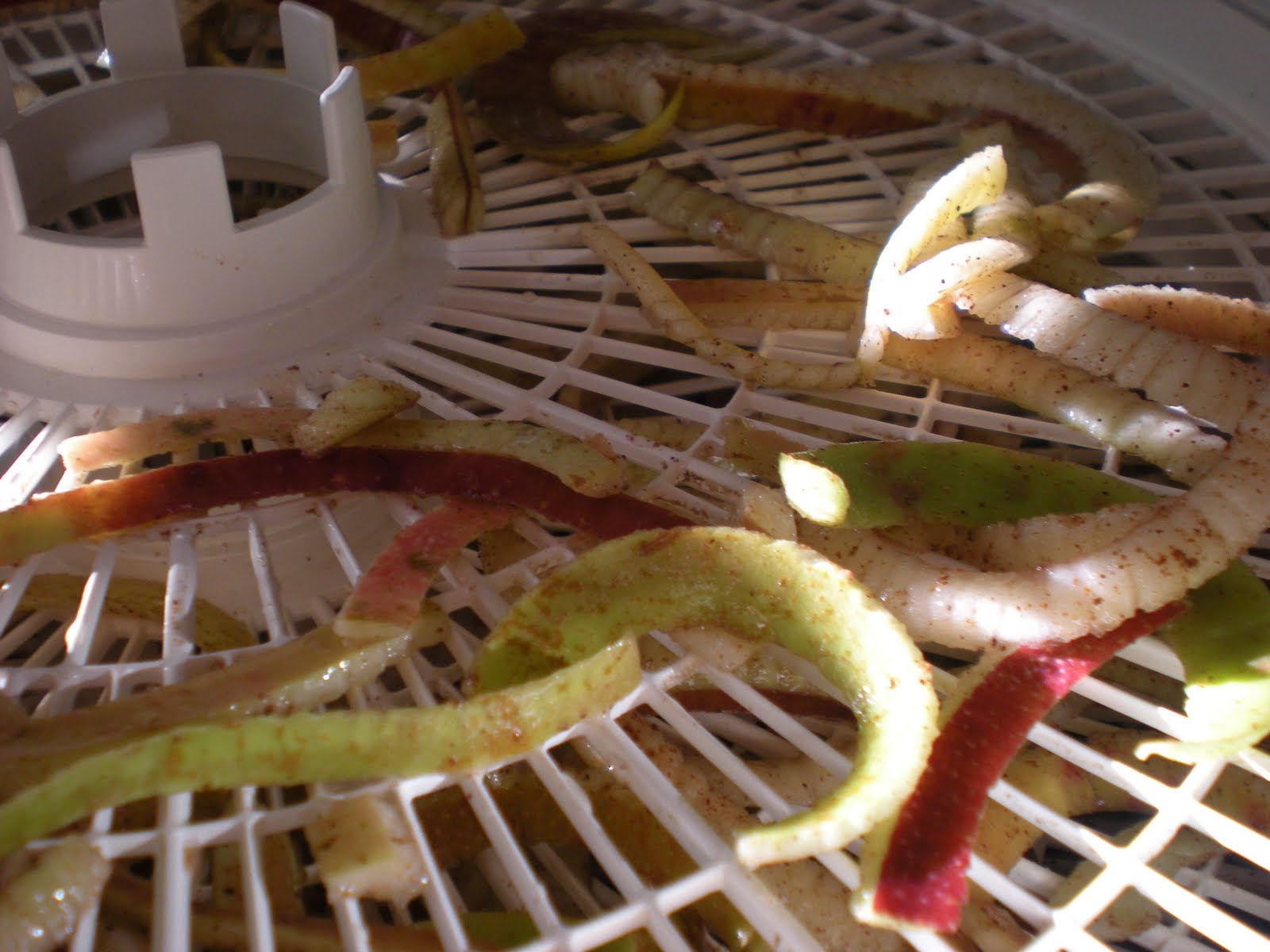
When the skins are done they will be crispy like apple chips!

Trial and error last week also informed me that apple skins produce a much better product with this method. The girls did not like the pear skins, which were chewier after dehydration.
--Rational Mama
Friday, October 1, 2010
U.K. Ration Day!
 Hello to all! Today is the day we start living on 1945 U.K. rations for the next two weeks!
A previous post outlined some of the rations and restrictions which were, unfortunately, a little squishy. Since I didn't have access to many first-hand sources I was making a sort of U.K. ration hodge-podge - a little 1943, a little 1945, etc.
Luckily, the ever so kind Mr. Graham (from On the Ration) set me straight. So, here's a rundown of our rations for the first week.
Standard Weekly U.K. Rations for Family of Four (1945)
8 oz preserves/syrup/treacle (Hagrid's favorite) (We have blueberry preserves)
32 oz sweets (We've gone with 27 oz sugar and 5 oz hard candy)
One pound bacon or ham (bacon this week)
32 oz butter/margarine/lard (We have 16 oz butter, 8 oz margarine and 8 oz lard...shudder)
8 oz cheese (Cheddar)
4 eggs (Drats! I can't find egg powder in this town!)
1.80 gallons fresh milk
milk powder - enough to make .6 gallons of milk
8 oz loose tea (no coffee or soda allowed)
Ribena concentrate for the girls (Our local grocery store had Ribena, Mr. Graham!)
2 cans concentrated orange juice
$8.32 for meat ration (Our antibiotic-free whole chicken was $8.30)
The monetary ration for meat was historically for red meat only, but to stay in line with our rationing year we will also include pork and poultry as part of this ration due to their current widespread availability (as compared with WWII).
There is also a standard ration of cod liver oil that I will not be subjecting the family to (I'm afraid Sissy would never speak to me again).
Then we have 24 points per week to use on tinned and dried foods. This is how we spent ours for the first week:
2 pounds oatmeal (8 pts)
1 pound dried beans - garbanzos (4 pts)
1 pound pasta (4 pts)
1/2 pound rice (1 pt)
1 pint condensed milk (2 pts)
1 fl oz olive oil (1 pt)
4 oz mayonaisse (4 pts)
Of course, local fresh produce and whole-grain breads are ration-free.
Soap rations are outlined in a previous post.
And then there's the gasoline rations...Under U.S. rations (and with a little 2010 math) our family is allowed 193 miles per week combined for both of our vehicles. Mr. Graham shared that gasoline rations varied during the war, with civilian rations of gasoline not being an option for a good portion of the war. He did related that if TMOTH's employment correlated with a wartime industry (which it would) then in early 1945 he would be allowed 9 gallons of gasoline per week which, using our 2010 math, would equate to 157 gallons per week.
Our weekly average has been closer to 180 miles per week, so we will definitely have to rethink our trips.
Of course, no appliance or clothing purchases are allowed and eating outside the home (restaurants, etc.) will only be permitted at two different (previously scheduled) family occasions during the two week period.
So there's the basics! Last night we went through the cupboards and refrigerator, storing away tempting items that are not allowed on U.K. rations. It was like removing all the hametz out of a house for Passover. Good bye crackers, gratuitous amounts of packaged cereal and cheese. Today we have nice, sparse shelves and a simple vegetable and dumpling soup.
We'll see how this goes.
--Rational Mama
Subscribe to:
Posts (Atom)