Saturday, May 8, 2010

A Grilling Dilemma

First off, let me say that I apologize for the lengthy 10 day delay in posting. I also want to shout out and say thanks to all who took part in the roll call (and it's not too late if you didn't, just click here).

It's been a busy 10 days of getting summer schedules set for the girls, finalizing planting plans and getting a new, improved job (yay me!). In the past 10 days we've also dealt with a dilemma that's been on the burner, so to speak, for a couple of years.

The dilemma is our grill.

Eight years ago when I was pregnant with Eowyn and Sissy was but a wee toddler we decided to upgrade from our traditional charcoal-powered college-years grill to a propane grill. I was tired of dealing with the briquettes and justified the expense by touting how much safer a propane grill would be (with an immediate "off" switch and faster cool-down period) with young children around. Our budget was tight, having just moved to our current burg and saving up funds for the new addition. So we went to Sears and bought a basic propane grill (I can remember that, with the sale and the mail-in rebate our cost was $109. Aren't I good at useless trivia?).

The grill had served us well, getting much use and decently holding up to our neglectful attitude (grill covers just seem too bourgeois). But last year it became painfully obvious that the grill was falling apart. Literally. Parts of it were disintegrating and causing uneven heating and flare-ups. But we didn't feel like we could dump the extra hundreds of dollars into replacing (and slightly upgrading) the grill because I was the receiver of one of the State's pink slips that went out last May because of the economic crisis.

But that's another (painful) story.

So we compromised and ordered a new flare guard (or, as I like to call it, heat shield) for the grill for something like 13 bucks. Not bad, eh? The burner was still experiencing it's own demise but at least with the new heat shield the food was only slightly scorched in places. With this purchase we could get through another summer and plan on buying that fancy new model next year.

But see, we didn't know then that we'd be rationing this summer (isn't that very historically accurate of us?). Buying new appliances during rationing wasn't necessarily a no-no, but it was to be done in emergency situations only. And we had already had one close call with the oven, remember?

But with the burner assembly literally falling apart, using the grill was about as refined and effective as using a Bunsen burner to cook a hot dog. What were we to do?

Luckily, the interwebs came to our rescue! We were able to order a new burner assembly and have it shipped to us for only $23. Within a week of ordering TMOTH had installed the new burner which, combined with the almost-new heat shield, has made our grill an evenly heated cooking machine.

I think, with the new parts, we'll be able to get at least two to four more years out of our grill.

The only problem is I now have to adjust to cooking with a fully-functional grill. I had memorized the hot spots before the repairs to avoid burnt food. Now grilling is so easy and simple it makes me feel, well...

...a little bourgeois.

--Rational Mama

Wednesday, April 28, 2010

The International Community of Rational Living (and a Roll Call)

One of the things that thrills me to no end about the Rational Living blog is using the reporting software to see where the readers live.

The majority of readers are locally based in Kansas, but there are several others in the Midwest including regular visitors from Illinois, Texas, Wisconsin and Colorado.

Other regular States-based visitors hail from California, Washington D.C., the Pacific Northwest and several coastal regions.

And then there's the regular international visitors. The wonderful readers from across the pond in the United Kingdom are always a welcome treat, and we have at least one regular reader in Nova Scotia.

Of course, there are those one-time visitors - readers that pop in for a brief glance at a page or two. Sometimes they're following a link from someone else's blog, other times they're following search results for SPAM or WWII rationing. Some of these visitors have hailed from such varied places as Egypt, Germany, Singapore, France, Russia, Somalia, Australia, Thailand, Romania and Iran (just to name a few).

The reporting software can't always decipher exactly where a visitor is from, and not all of our regular visitors officially follow us through the Blogger system.

So, dear reader, can you please be so kind as to de-lurk (if necessary) and leave a little note stating where you are from? It would give us a better understanding of just how big and expansive the Rational Living community has become. You don't have to put anything personal, but if you have an idea, question or suggestion you can throw that in, too.

Thanks a bunch!

--Rational Mama
(Reporting live from Kansas, U.S.A.)

Monday, April 26, 2010

The Five Minute Environmentalist

This past Sunday I was one of a handful of speakers at our local fellowship's Totally Green Service (always the Sunday closest to Earth Day). While other speakers from older generations spoke about what they've done to help the environment in the past up to the present, my task was to talk more about the present and what I hope the next 40 years of Earth Days will bring. My time limit? Five minutes! It is very challenging to say anything worthwhile in five minutes, but this is what I produced (which, admittedly, is closer to six minutes in length). As always, names have been changed to protect the innocent (and the guilty).

What it means to be an environmentalist has changed a lot in the past 35 years that I've been on this planet. When I was in elementary school Earth Day was never mentioned and my only awareness of what it meant to be an “environmentalist” was that you weren't supposed to litter and that you were happy that the air was cleaner because cars now used unleaded gasoline. The monthly trip to the Golden Goat aluminum can crusher was more about getting change in your pocket than how recycling could help the planet.

By the time I was in high school it was cool to be concerned about the threatened existence of cute little tree frogs and read the writings of Al Gore. Being an environmentalist in the 1990s meant, at least in mainstream circles, that you were protecting the Earth for the Earth’s sake. That you should protect that tree frog because of the unique and irreplaceable role that species plays in the interconnected web of life.

While being eco-friendly in the 1990’s was the right thing to do, and celebrating Earth Day was hip, being a “real” environmentalist required the type of forethought, planning and work to which few of us were willing to fully commit. After all, they’re just tree frogs.

After the millennium there was more talk about preserving biodiversity, but now new options and information were available to help the self-proclaimed environmentalist make responsible choices. Did you remember to bring your canvas bags to the grocery store? Have you tried the new organic potato chips? Have you heard about the new hybrid cars that are coming? Did you make your Earth Day resolutions?

Suddenly, two barriers to making environmentally-sound decisions - information and convenience - became less of an issue. I could save the planet just by eating the right yogurt or using a specific brand of toothpaste!

But with personal choices come personal responsibilities. Once you start making serious and sincere decisions based on environmental consideration, it’s challenging to draw an arbitrary line in the sand and stop. You find yourself making increasingly hard, and inconvenient choices. Choices such as using cloth diapers or cloth menstrual pads instead of the disposable alternatives - even if some people will never understand why. Or choosing food limits which make potlucks a minefield and leaves you explaining to your family for the umpteenth time why you prefer to make your own baby food. It means accepting the fact that new coworkers will wonder if the reason you walk to work is because you’re too poor to afford a car or have some disability which prevents you from driving one.

And even with today’s general acceptance of living a “green lifestyle,” being an environmentalist can still make you an outcast. That story about walking to work? That's a true story - my story - and you can bet I haven’t had the cloth diapers and pads conversation with that coworker yet. But the truth is is that sometimes being an environmentalist and making these decisions can make you feel like an outsider, and that can get you thinking about people and why you’re doing all of this in the first place.

Once you start making choices every day about how you’re going to use our planet’s limited resources, you realize that the reason you’re making these decisions isn't so much about a sense of responsibility and obligation to the tree frogs, but out of a sense of responsibility and obligation to other people. Because these resources aren't, or at least, shouldn't be, just mine or ours. They belong to everyone. They are to be used carefully, wisely, and judiciously.

And they should be used to meet the needs of many, not just the wants of a few.

So, each year when Earth Day comes around and I make choices, I make choices because the environment and humanity are tied together in a way that is complex, beautiful, and scary. When I choose to eat less meat (and encourage others to do so), it is in hope that agricultural resources used to grow food for livestock might instead be used to grow food for people who desperately need it. And when I choose to buy a specific brand of tomato sauce, I buy it because that company has a track record of paying it’s workers fair wages. And when I do things like hang my laundry out to dry, or choose to live on WWII rations for a year, it’s so that my resources - my time and money - can be spent on helping others who need it.

Our family has used some of the money we've saved this year from rationing to sponsor a child, a little girl named Amanthi, from Sri Lanka. She is the same age as Sissy (our oldest daughter) and lives in a remote and primarily agricultural area. Why this may seem like more of a social justice (rather than environmental) choice the lines are, in fact, blurred.

If Amanthi does not have clean water because of agricultural run-off she will get sick. If her family plants crops that are not suited to their region she will go hungry. If her village experiences mudslides during the monsoon season because of loose topsoil resulting from deforestation, she suffers. And if she suffers, or is ill, or hungry, she cannot go to school. She cannot learn. And she cannot improve her life and that of her family.

Amanthi’s life is tied so directly to her environment it is a blatant and undeniable relationship. Our lives, in reality, are like that, too. But our dependence is camouflaged by bright shiny toys and plastic packaging. But in the end, we’re all in the same boat…or at least, on the same planet.

And so I hope that the next 40 years will bring about a greater understanding of how environmental issues and those of social justice are inextricably interwoven in such a tight way that if we can improve one then the other will rise as well.

If we respect the environment, then we respect humanity…and vice versa. After all, being an environmentalist in this post-modern world is really just about being a good human.

As Tree Hugger blogger Chris Tackett has said, “Environmentalist has become a useless term because no one seems to know or agree on what it even means. If it means having clean air, water and food, we’re all environmentalists.”

And all of us deserve clean air, water and food.

--Rational Mama

Sunday, April 25, 2010

A Tisket! A Tasket! Our First CSA Basket (of the year)!

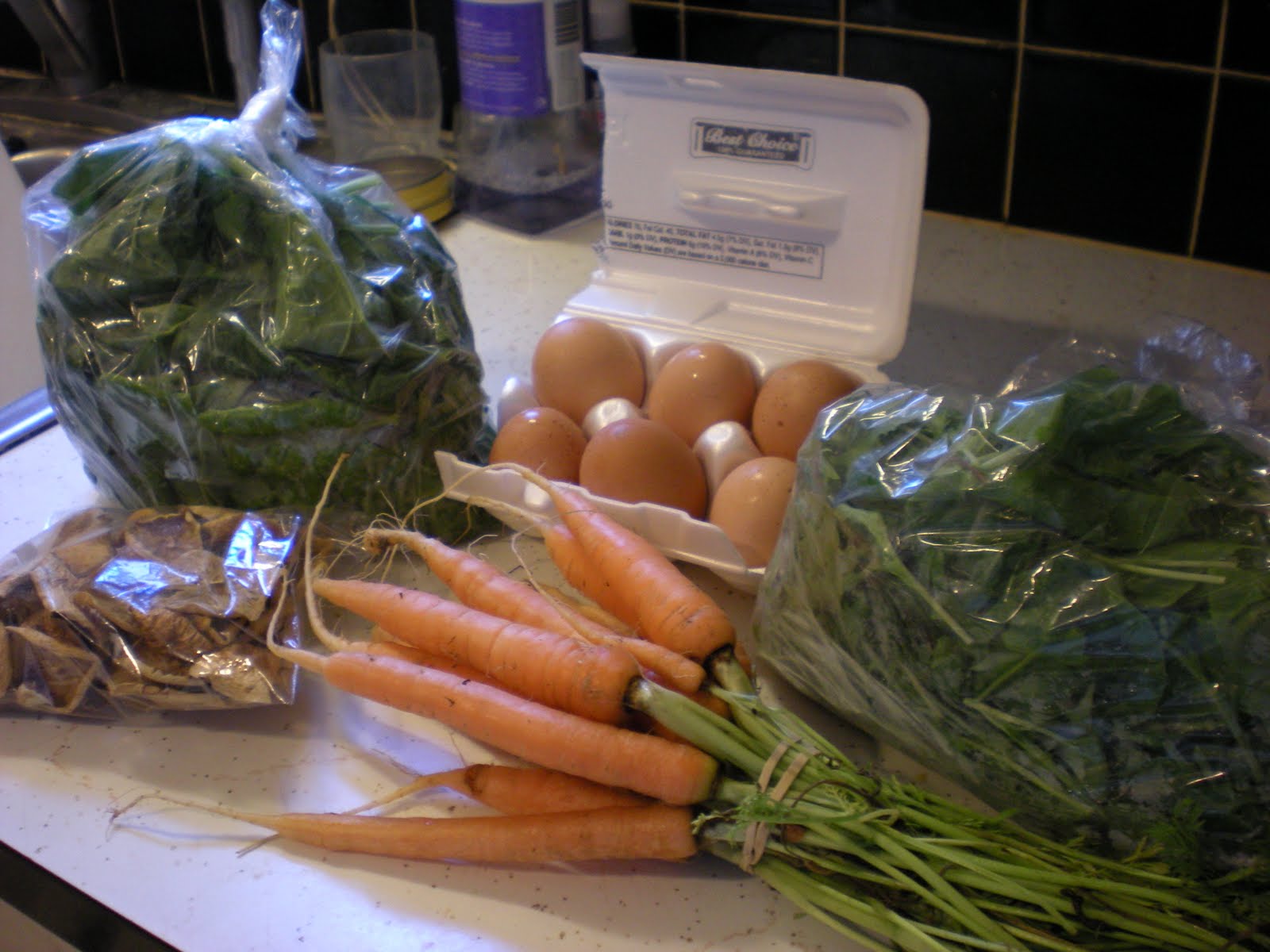
Friday was the first pick-up day for our CSA subscription through the local natural food co-op. Here's what it contained:
Just in case you can't tell from the photo, that's a half-dozen farm fresh/free-range eggs, a bunch (literally) of carrots, a bag of dried Nameko mushrooms, a bag of salad greens and a bag of spinach. This collection is a little bit smaller than the usual weekly pick-up (the growers had a hard time harvesting with all the rain we've had), so they charged us a bit less than the normal weekly fee.

Yum! All fresh, all local and all un-rationed! One of the best parts, though, is the newsletter that comes with the weekly bag. This week's newsletter explains that, "each week's bag holds gastronomic treasures and culinary mysteries for you to behold." Seriously. Is this not the most awesome food newsletter ever?

With the fresh greens available through our own garden, the farmer's market and our CSA subscription we've eaten a ridiculous amount of salad in the last week. This makes me very happy.

Not tonight, though. Tonight's dinner is very fitting for the cool, rainy day we've had here: chicken pot pie. Eowyn requested it late last week and so I just took my second attempt at making pie crust (you can revisit my first attempt here). I used a different pastry recipe and the results are much more aesthetically pleasing. The contents of the pie also include a homemade white/cream sauce, which replaces the store-bought can of cream of chicken soup I would have used prior to rationing.

And if tonight remains cold and dreary I might just need to make a batch of homemade chocolate chip cookies - no cookies from a tube here.

Ah, how some things have changed!

--Rational Mama

Monday, April 19, 2010

How to Lose 1 Pound of Fat Per Month

Greetings, readers! Today's topic is that much-hated scourge of middle age: fat. But I'm not talking about a spare tire or love handles. I'm talking about...well...fat! Cooking fat!

In the 1940's it was not unusual for the dutiful housewife to keep reusing her cooking fats until there was nothing but sludgy grit and granules left. Then, down the drain or out with the trash the remaining gloop went. While this may sound especially reasonable during WWII rationing restrictions this practice actually caused a dilemma during the war: the U.S. government needed those fats to extract the glycerin necessary for making bullets and bombs!

Thus, in the middle of all the rationing hype you find plenty of reminders (such as this one from the March 30, 1943 Topeka Daily Capital) for women to not dispose of their waste fats but instead to set aside an amount for Uncle Sam.

With cooking oils being high-point items on the rationing list and consumers inclined to keep the waste fats for their own use (plenty of WWII recipes include a tablespoon of bacon or meat grease in place of shortening and/or oil), how was this campaign ever going to be successful?

In typical American fashion, the answer was bribery! Yes, for one pound of grease per month you could earn an additional two red ration points. Aha! Now we're talking! Civilians could bring their jars or cans of stored waste fats in to their butcher for the bonus two points.
Just by setting aside one tablespoon of waste fats per day the average household would have their one pound donation by the end of the month.

It takes our household much longer to come up with that much waste fat since we do not fry as much food as was typical in the 1940's. In fact, most of our waste fat has come from the two times I've made fried chicken. As such, we have been able to turn in two one-pound containers of fat so far. I don't see that number increasing dramatically as one of the things that rationing has taught me is that I'm absolutely repulsed by shortening. Ugh.

Oh, and one final thought here: anyone who touts U.S. WWII rationing guidelines as a weight-loss scheme isn't being honest with you. While certain things like fats, cheeses, butter and meats were rationed, most grain-based items were not. So, while you might not be allowed your thick-cut steak you can fill that void with crackers, bread, potatoes and a heaping handful of sweets if you portion out your sugar ration just right. Civilian rations in the U.K., however, were quite Spartan and more than one example exists of that type of system leading to weight loss.

In the meantime, I'm happy to stick to our U.S. civilian rations, especially with the prospect of fresh fruits and vegetables just around the corner. Summer will clearly be the golden age of the rationing year.

--Rational Mama

Thursday, April 15, 2010

Historic Recipe: Cabbage Delmonico (and, a farewell to a good friend)

Friends, throughout the course of this experiment you've read my ruminations about cabbage. Ah, that staple of restricted wartime winter diets; the only source of semi-fresh green leafy things for many months. We've baked it, made various salads out of it and had moments of frustration with it.

Today, I honor cabbage with another historic recipe: Cabbage Delmonico. The recipe comes from Joanne Lamb Hayes' Grandma's Wartime Kitchen: World War II and the Way We Cooked and is described as a "meatless main dish." Here's my version as I made it...

Ingredients:
2 lb head of cabbage
2 TB butter
3 TB all-purpose flour
1/2 tsp dry mustard
3/4 tsp paprika (Hungarian is best)
3/4 tsp salt
2 cups milk
1 cup grated extra-sharp Cheddar cheese
1/2 cup bread crumbs

Cut cabbage into 6-7 wedges and cook in boiling water for about 5 minutes (the recipe said to boil for 8 minutes but I didn't want to overcook my cabbage, per grandmum's instructions). Drain the cabbage.

In a small saucepan melt the butter over low heat. Gradually stir in the flour, mustard, paprika and salt until smooth. Gradually stir in the milk, stirring constantly over low heat. Add in the cheese bit by bit and stir until all the cheese is melted.

Place cabbage in 9" x 9" baking dish and top with the cheese sauce. Sprinkle the bread crumbs and extra paprika over the top and bake for 20 minutes.

This is what it looked like coming out of the oven:

And this is what it looked like on the plate:

Sigh. Can't cabbage ever look attractive? If you have an even half-way decent imagination then you can ascertain how this dish turned out. After all, it's pretty much just cabbage and a mild cheese sauce. I'm not sure if the "meatless main dish" description is historically true, or just one the cookbook's author felt fit well. Either way, there's not enough protein or carbohydrates to make this a satisfying meal.

Cabbage, dear cabbage...you're like the Susan Boyle of rationing. Humble? Yes. Comely? Yes. Underestimated? Yes. And then you get your chance to shine and surprise us all by how tasty you can be in such dishes as baked cabbage and Asian cabbage slaw.

But like Susan Boyle, your moment to shine will fade...and so fade, you must.

Due to the seasonal restrictions on our produce selection, this will be the last time we purchase/prepare cabbage in the house until late summer. The next few months will be filled with fresh spinach and lettuce and many other green vegetables which have waited anxiously to have their moments of recognition.

And so, cabbage, this is farewell. At least, until late August.

Adieu.

--Rational Mama

Sunday, April 11, 2010

Eating Out and Filling Up (with Guilt)

Remember waaaay back at the beginning of the Rational Living year when all the household members predicted that the self-imposed limitations on eating out would be the hardest part? And then in February I blogged this entry:

We are all surprised at how manageable the transition to reduced restaurant visitation has been.

It was like we were some bad-ass non-eating out ninjas who could quickly and silently whip up an easy dinner in the chaos of the day. Only a half-hour to eat between getting home and piano lessons? No problem! Running errands that conflict with lunch time? Just grab some snacks to tide us over until we eat a real meal at home.

Yeah, that was so February.

In the past few weeks we've definitely been experiencing a backslide in this category. An extra dinner out. Grabbing a quick sandwich while out shopping (who can resist the $5 foot-long with that catchy song?). And I was beginning to feel guilty about this slide, because we originally planned to reduce our allotted rationing points on the weeks we went out and because I'm very quick to feel guilt (seriously, it's amazing I'm not more religious with how quickly I can feel at blame even if I'm not).

We had decided to reduce our ration points during eating-out weeks because I had read in several sources general comments about how during WWII rationing consumers had to turn over ration points for meals eaten in restaurants. This made sense, since eating in restaurants would be an easy way to supplement rationing if points weren't involved.

So I did a little more research to see just how justified my guilt was for our recent transgressions. I had a hard time finding any specific information until I found this little gem. It's an article from the May 5, 1943 Wichita Eagle entitled, "Persons Eating Regularly At Cafes, Institutions, Must Pay Ration Points." Finally! Here was a historical source that would accurately admonish our current behavior and set us on a straight and righteous path when it comes to eating out during the rationing year!

The article clearly concludes:

OPA regulations state that all persons who consume eight or more meals a week in a restaurant, hotel dining room, hospital or institution which has registered as an institutional user of processed food, meat, and fats, shall surrender their ration books to the owner or operator of such places of business, and stamps will be removed by the management for the periods which stamps are currently valid. The books in turn will be turned back to their owners at the expiration of the period which the persons are receiving meals in such institutions. [bold added]

What? What? What? Eight or more meals a week? What? Seriously? You don't have to surrender ration points unless your eating eight or more meals out a week? I don't think I've ever eaten eight times out in a one week period, in my whole life!

Oh hell. Let me tell you, dear reader, that that foot-long sandwich is gonna taste a whole lot better without the extra side of guilt.

--Rational Mama